Before commuter matatus reclaim Nairobi’s Central Business District, Edwin Otieno arrives with a portable Bluetooth speaker, a ring light and a smartphone clamped to a tripod. The pavement is still open enough to become a studio. Soon, the speaker is thumping, a circle is widening, and the polished stone is carrying the weight of a dance floor.
Otieno is 24, an automotive engineering graduate whose diploma has not yet opened the career door he expected. On Sundays, he takes part in high-energy dance routines along the streets and for the thousands who may encounter the footage later on TikTok or Instagram. The performance is free to watch, but it is not free to produce: it is the first step in a chain that runs from public attention to private contracts, from a phone camera to rent money.
“My plan was always to secure an engineering job first and dance on the side. Right now, the engineering job isn't there. So I dance. The video on the street is the enticer, you build the numbers out here, then go live online so viewers can support the craft.” Edwin Otieno, automotive engineering graduate and street dancer
That chain is the central business logic of Nairobi’s pavement economy. Across the city centre, young dancers, photographers, skaters, interviewers and comedy producers are using public space as an open-access production set. The scenes look improvised, but the work is increasingly deliberate. Creators arrive with formats, collaborators, equipment and posting schedules. They know that the crowd in front of the lens is only one audience. The larger audience is elsewhere, waiting behind a screen and an algorithm.

A view along City Hall Way in Nairobi’s Central Business District, where youth creators gather every Sunday. Source: Edwin Austin
A city centre that became a set
The weekend gatherings did not emerge from a vacuum. Capital Business News documented Nairobi’s Sunday street-creation scene through interviews with young photographers and TikTok creators. It described groups of photographers, choreographers and TikTokers using the quieter weekend CBD as a production space. They noted that photographers approached passers-by, charged for portraits and delivered images through WhatsApp. It also reported that one photographer could make up to 30 portraits on a good day, charging about US$0.65 per image, while creators used the city centre to build audiences and professional networks.
They linked the growth of the scene to Nairobi County’s removal of photography permit fees and daily shooting charges in 2022. The county later described Sunday content creation as part of its creative-economy and tourism agenda, saying creators could film around the city without restrictions and free of charge.
What that policy changed was not only the cost of taking a picture. It altered who could enter the business. A young person with a borrowed camera, a phone and enough confidence to approach strangers could begin without renting a studio or paying for a formal location. The street lowered the threshold, even as it left the creator responsible for nearly everything else: equipment, transport, editing, data, security, marketing and the unpredictable search for a paying client.
The formats now visible around the CBD are varied. Vox-pop interviewers walk with lapel microphones, turning relationship disputes, cultural arguments and quick public opinions into comment-section fuel. Street photographers offer fast portraits, often retouched and delivered through WhatsApp within minutes. Stylists and models use government architecture along City Hall Way as a free visual backdrop. Roller-skaters turn the city’s corridors into routes, documenting group cruises before attempting long-distance runs to places such as Machakos and Ngong.
Each format solves the same problem differently: how to turn presence into attention, and attention into a transaction. The creator is not simply making a video. The creator is building a small media business in public, with the city providing the set, the passers-by providing atmosphere, and the platform determining which work is seen.

Otieno and members of his dance team practicing in downtown Nairobi before recording for social media. Source: Edwin Austin
The first payment is often not money
For David Nyabuto, a third-year Community Development and Environment student at JKUAT, the most direct route to cash is still the photograph. He charges between KSh100 and KSh200 for a professionally retouched image and says a focused Sunday session can bring in KSh2,500 to KSh4,500 through direct M-Pesa transfers. The work is modestly priced, but its immediacy matters. There is no application process, no interview panel and no waiting period between delivery and payment.
“Entry-level opportunities for young people in Nairobi pay peanuts. On a good Sunday, street photography sustains my rent, food, and university fees far more reliably than an unpaid or low-stipend internship.” David Nyabuto, street photographer and JKUAT student
The income does not arrive because a platform has selected the creator. It arrives because one person has decided that a picture is worth paying for.
For performers such as Otieno, the economics are less immediate. The pavement may produce no cash at all. Its purpose is to create the footage that will later pull viewers into an evening livestream. The street is the enticer, as Otieno puts it, a kind of customer-acquisition channel where movement, noise and the architecture of Nairobi make the content feel more alive than a studio imitation.
That distinction separates two kinds of creator work. One sells a product directly, usually a photograph or a performance. The other sells access to an audience, hoping that gifts, sponsorships, appearances and future bookings will follow. The second model can scale further, but it also exposes the worker to the platform’s rules and to the volatile mathematics of visibility.

Skaters practicing along Aga Khan Walk in Nairobi_s CBD. Source: Edwin Austin
The ladder from emerging creator to brand deal
The following income ranges are indicative field estimates drawn from interviews and income examples gathered, and not entirely cast on stone. At the emerging end, creators with roughly 1,000 to 15,000 followers reported monthly earnings of about KSh15,000 to KSh35,000 from street-photography fees and small platform gifts. Active and consistent mid-tier creators, with audiences ranging from approximately 20,000 to 100,000, reported monthly net earnings of about KSh45,000 to KSh90,000 from livestream battles, dance gigs and local-business promotions.
At the established end, creators with 150,000 or more followers may earn KSh120,000 to KSh300,000 or more when corporate retainers, music-video appearances and agency deals become available. These figures are not set in stone. They vary according to audience loyalty, platform access, the number of bookings and the creator’s ability to convert online visibility into paid work.
The problem is that the ladder has missing rungs. Follower numbers do not guarantee a contract. A viral clip can deliver recognition without a booking, while a small but loyal audience may produce a steadier stream of direct customers. The creator has to keep working even when the algorithm goes quiet, because visibility itself has become a form of unpaid labour.
The apparent generosity of livestream gifts can be misleading. Viewers purchase coins, use them to send virtual Gifts, and TikTok converts those Gifts into Diamonds, which are used to measure creator popularity and engagement. TikTok’s Virtual Items Policy states that Diamonds do not automatically entitle a creator to a fixed cash payment and that compensation is calculated using several factors. Its LIVE creator guidance says the platform shares 50 percent of its net revenue from virtual items after deductions for app stores, payment processors and other adjustments. The figure therefore does not mean that a creator receives half of every amount spent by viewers. The final payout can vary according to the type of gift, platform eligibility, regional availability, payment deductions and the rules governing withdrawals.
The distinction matters in Nairobi, where the final payout may also meet currency-conversion, withdrawal and payment-processing frictions. A gift that appears large on a livestream can become much smaller by the time it is converted into an amount that can pay for food, transport or a room. TikTok’s support material further makes eligibility conditional on location, age, account standing and access to the relevant features.

Pedestrians and creators along City Hall Way in Nairobi on a Sunday afternoon. Source: Edwin Austin
When a view becomes a booking
The strongest creators do not treat online attention as the destination. They use it as a portfolio. A dance routine becomes proof of reliability for a music-video director. A street interview becomes evidence that a presenter can hold a crowd. A sequence of portraits becomes a visual calling card for a wedding client, a corporate communications team or a fashion label.
The offline pipeline is where the economics can change scale. Street dancers reported music-video payments of KSh10,000 to KSh30,000 per dancer per project and higher for more established musicians. Viral performers may be invited to corporate activations, beverage roadshows, telecom campaigns and fashion promotions.
Street interviewers can move into nightlife hosting. Photographers can graduate from KSh100 portraits to private events, commercial lookbooks and corporate work. None of these transitions is automatic, but the public pavement functions as a low-cost audition stage for industries that have traditionally relied on agencies, studios and formal networks.
Africanews reported in January 2025 that Nairobi dancers were earning from TikTok tips, YouTube advertising and party performances, while a street fashion model with more than 200,000 followers used her account to advertise products for clients. The publication captured the same hybrid economy visible in the CBD: online visibility, direct fan support and offline bookings reinforcing one another, without any single stream being dependable on its own.
This is why the street can look busier than the balance sheets suggest. A creator may be filming for the future, not earning on the day. A crowded circle is a marketing asset. A collaboration is a distribution strategy. A stranger who agrees to appear in a clip may become a customer, a follower or a link to somebody who can pay.

Street interviewer and mass media graduate Ndavi in Nairobi CBD. Source: Edwin Austin
The informal infrastructure behind the spectacle
The pavement economy also depends on cooperation. Creators share lenses, microphones, ring lights and power banks because the cost of owning every tool is too high for a beginner. Established dancers bring newer performers into routines and groups assign security spotters to watch equipment while a camera is rolling, particularly when phones and camera bodies are exposed in crowded areas.
These networks are easy to miss because they are not registered as companies. Yet they perform many of the functions of a company. Their weakness is the same as their strength. They are flexible, but they depend on trust, personal reputation and the willingness of more established creators to share access.
The result is an industry that is social before it is formal. Its most valuable assets are not only devices and follower counts, but relationships: who can bring a crowd, who can edit quickly, who knows a promoter, who can get a performer onto a set and who can keep watch when the group is working in public.
A new chapter in an old argument about space
Urban planner and researcher David Kabuu places Nairobi’s Street creators within a longer history of young people using public culture to contest who the city is for. Nairobi, the colonial city center, he argues, was designed for administration and commerce rather than congregation. The contemporary crowd answers that design not with a petition alone, but with a speaker, a camera and a choreography that makes the walkway temporarily theirs.
“Nairobi was planned under colonial segregationist zoning, the city center was engineered purely for administrative transit and commerce, never for public congregation. Street culture has continuously pushed back against that design.” David Kabuu, urban planner and cultural researcher
Kabuu traces a line from the matatu revolution of the 1980s and 1990s, when minibuses became moving canvases of graffiti, sound and Sheng, to the hip-hop communities that gathered around Nairobi’s cultural venues in the early 2000s. Published work on matatu graffiti describes it as a form of youth self-expression and social commentary, while writing on Kenyan hip-hop records how Kalamashaka and Ukoo Flani Mau Mau turned urban frustration into public language.
The continuity is not literal. The matatu was a moving billboard; the TikTok clip is a portable broadcast. But both forms make culture visible outside the institutions that usually decide what counts as culture. The difference is that today’s street performance is captured at once for two spaces: the pavement where it happens and the platform where it may travel and even go viral.
The crowd is also a marketplace, and a risk
The Sunday economy does not stop with creators. Mobile beverage vendors benefit from the foot traffic. Kenneth Isavwua, who operates a refreshment cart near the KICC, says the youth gatherings can double his sales when schools close and more teenagers join the crowd.
“When schools close and high school students join the crowd, my sales double. Sundays are my absolute best days. More young people in town means better business for street vendors.”
Kenneth Isavwua, mobile beverage vendor.
But the same density that creates customers can unsettle other traders. Along City Hall Way, beadwork and curio seller Caroline Odinga says dance crews rarely buy her handmade jewellery and cultural artefacts, while crowds create cover for theft. She does not object to young people expressing themselves, she says, but she objects to a public space becoming too crowded to police safely.
“I have no issue with youth expressing themselves, but severe overcrowding provides a breeding ground for crime. Recently, two of my customers were robbed right outside my stall. One lost a gold necklace and was scratched, while another had her phone stolen moments after purchasing earrings.” Caroline Odinga, beadwork and curio trader.
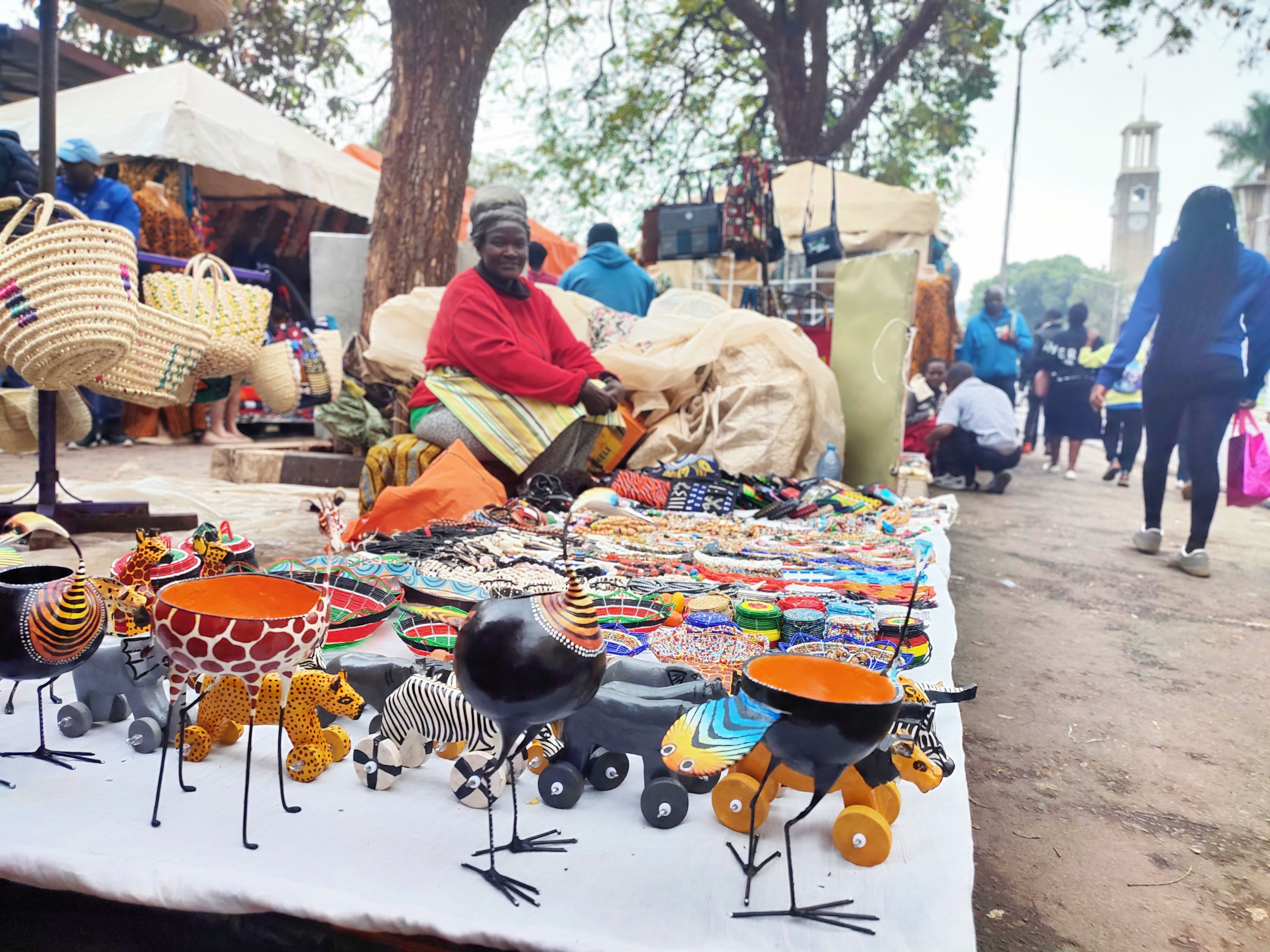
Caroline Odinga, a trader at the open-air Maasai Market along City Hall Way in Nairobi’s CBD. Source: Edwin Austin
Creators carry their own version of the risk. A smartphone is both camera and wallet, and a camera body can represent months of savings. Ndavi, a street interviewer and videographer, says producers carrying expensive equipment can become conspicuous targets for pickpockets. The public studio has no locked equipment room, no insurance desk and no guaranteed security perimeter.
The policy gap beneath the creative boom
Nairobi county has publicly promoted Sunday filming as a way to support the creative economy, but creators describe enforcement as uneven. Some report threats of arrest under public-nuisance or loitering rules and say they have been asked for informal payments of KSh500 to KSh1,000 to avoid equipment confiscation. Those allegations require independent verification, but their recurrence points to a familiar problem: a policy can be liberal on paper and uncertain on the pavement.
The position given by an anonymous county enforcement official is narrower: filming itself is not prohibited, but crowds cannot block pedestrian routes or access to government offices. “There is no law against young Kenyans filming TikTok videos in town. However, when crowds obstruct main pedestrian corridors or block access to key government offices, officers are mandated to disperse them peacefully.”
The county’s policy position has since become more complicated. News published on 23 August 2026 said Nairobi’s 2026 Finance Act introduced charges of KSh8,000 per local commercial filming session, KSh50,000 for external productions and KSh10,000 for music-video production. It also listed annual charges for content-creation studios and fees for monetised influencer events.
“These charges were never intended to target ordinary content creators, influencers or young people creating digital content. We intend to regulate professional and commercial film productions that require significant use of public spaces and infrastructure.” Johnson Sakaja, Nairobi Governor.
The following day, Sakaja clarified that the charges were intended for professional and commercial productions involving large crews, specialised equipment and extensive use of public infrastructure, rather than ordinary young people filming routine social-media content. NTV Kenya reported the same distinction, noting that the county’s clarification came after concern among filmmakers and digital creators. The distinction matters for the street creators in this story, whose work often sits between informal personal content and commercial production.
Tax is another part of the gap. The Kenya Revenue Authority lists payments for digital content monetisation, sales promotion, marketing and advertising among incomes that can be subject to withholding tax. Its guidance also says resident recipients generally have to declare income and claim credit for withholding where the deduction is not final.
That language is technical, but its consequences are not. A creator who thinks of a brand payment as a one-off windfall may actually be operating a taxable business. Ironically, the creator economy is becoming visible to regulators before it has become secure for the creators themselves.

Street vendor Kenneth Isavwua serves customers from his refreshment cart outside the KICC in Nairobi. Source: Edwin Austin
Can the pavement pay the rent?
The short answer is yes, for some creators, but rarely through one stream and never by virality alone. Street photography can generate cash the same day. Livestream gifts can supplement income but depend on platform eligibility, audience loyalty and deductions that are not always transparent to viewers. Brand deals and music-video bookings can change a month’s income, but they arrive irregularly and are distributed unevenly.
Studies of Kenya’s digital media and creative economy argues that the sector carries real potential for youth employment while remaining constrained by limited finance, weak policy frameworks and low labour-force participation. The study does not establish the income tiers used in this article. Its recommended path is not simply more content. It is investment, partnerships, stronger capabilities and models that help successful creative work scale.
That is the structural question hiding inside the Sunday spectacle. The young people on Aga Khan Walk are not waiting for the economy to recognise a job they already have. They are assembling one in public, piece by piece. But a self-made workplace is not the same as a secure livelihood. Without predictable rules, transparent compensation, affordable equipment, safer public spaces and pathways into formal contracts, the pavement can remain an incubator without becoming an institution.
Urban planners and creators have a practical wish list: designated performance zones with power and basic amenities, clear rules for filming, standardised micro-tipping systems and corporate compensation that does not treat young talent as disposable. My dearest reader, these are not demands for the city to manufacture creativity. They are demands that the city acknowledge the economic work already taking place in its open spaces.