Arriving in Arusha, Tanzania
Hassan Abd-Alwahid arrived in Arusha, Tanzania, on a cool Saturday in 1987, as an expert for the Pan African Postal Union. He boarded a Lufthansa direct flight from Khartoum International Airport to Kilimanjaro International Airport. At that time, that plane ticket went for 109 Sudanese pounds. This is the story of how a Sudanese man carried Sudan with him for 40 years, in the country that became his second home; Tanzania.
Hassan Abd-Alwahid was born in Khartoum, Sudan, on March 18, 1940. After graduating from university, he worked at Sudan’s postal services “Bareed & Barg”, until reaching the position of Deputy Director in 1986. In 1987, Hassan was chosen as an expert for the Pan African Postal Union and arrived in Arusha, Tanzania. He worked for the union for 14 years, traveling across the continent, experiencing its beauty and diversity, yet, choosing Arusha, Tanzania as his home. Hassan Abd-Alwahid is the father of 11 children - 9 from his Sudanese wife, Fathiya, and 3 from his Tanzanian wife, Kawther.

Hassan Abd-Alwahid, Graduation Photo
Come Again About Arusha?
Arusha City, located in Arusha Region in Tanzania, is a beautiful and serene city with cool moderate climate. Situated below Mount Meru on the eastern edge of the eastern branch of the Great Rift Valley, it is considered a gateway to safari destinations such as the Serengeti National Park and the Ngorongoro Conservation Area, in addition to Africa's highest peak, Mountain Kilimanjaro.
Notably, Arusha, as a reflection of Tanzania itself, enjoys a diverse yet harmonious society. One finds Christians, Muslims, Hindus, and Sikhs, among others, all peacefully coexisting and thriving.
These factors have contributed to Arusha being a diplomatic hub throughout the decades. We find in the city the African Court on Human and Peoples' Rights, the South-East African Management Institute, as well as Arusha International Conference Centre. Not to forget that Nairobi, the beating pulse of East Africa and Kenya’s capital, is only 200 km away.
Arusha City, Miscellanious – Short Video
The Sudanese Way
When Uncle Hassan arrived in Arusha, there were three hotels in the city; Mount Meru Hotel, Arusha Hotel, and Hotel 77. With the staff of these three hotels, he had a very interesting arrangement.
He agreed with them that whenever a Sudanese guest arrived, they would call him, and he would arrive at the hotel that same day or the next at the latest to welcome the guest, take them for a drive, and introduce them to the city. The newly arrived person would be happy to get a welcoming company on those first few days and to lose the tension of estrangement in a new place. Uncle Hassan on the other hand, would be happy to find a bit of home in the person who had just arrived.
As years had passed, and hotels increased in number, the concierge arrangement gradually ended. However, by that time, Uncle Hassan had gained a reputation within the Sudanese circles and spaces, that Sudanese traveling to Arusha had to engage with him, like they engage the embassy, the Bank of Sudan (for government officials attending conferences), and the Ministry of Education (for Sudanese students). For these people, someone would always say, "Look for Hassan Arusha," and the newcomer would surely find Uncle Hassan, through acquaintances, or Friday prayers at the city mosques.
After meeting Uncle Hassan and his family, they would enjoy Sudanese warmth and a feeling of home away from home, infused with a Tanzanian hospitality. In that way, Uncle Hassan, his family, and his house, became an extension of Sudan itself, in the heart of Tanzania.
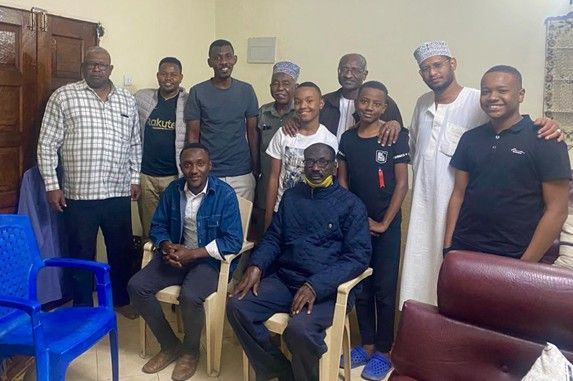
A gathering at Hassan Abd-Alwahd’s house in Arusha, Tanzania
Safeguarding The Sudanese Way
I asked Uncle Hassan about living and safeguarding the Sudanese tradition and virtues of generosity and solidarity; he said that these traits were instilled in him as a child. He drew an example from his youth days in Dongola, in the Northern State of Sudan.
In those days, he used to help his father with their shop, and when the evening came, they wouldn’t simply close off the shop and go back inside the house, but he would spend the evening with his peers on a mat “Beresh” in front of the house, with a traditional pot of fava beans “Qidrat fool” cooking near them for supper, they would welcome all passerby to sit and join in for the meal. From such days and lessons Uncle Hassan learned the essence of Solidarity within the Sudanese society, in his words, “the community was connected, and a connected community is a homogenous and integrated”.
On a different occasion, while doing his postgraduate studies in Germany, Uncle Hassan received the news of the birth of his son Haytham, the celebration of Haytham’s birth, as we call in Sudan “Simaya” was a grand event that gathered Sudanese from all over Europe, who came with their Guitars, Drums, and Ouds. The celebration was so big that the German police came to inquire about what was happening, and the “Simaya” ended up being featured in a German Newspaper.
Tanzania Becoming A Second Home
Uncle Hassan was granted Tanzanian citizenship in 2004, after living in Tanzania for almost three decades, forming a family with his Tanzanian wife, Aunt Kawther, and their three children, whom he considers as “Sudanese seeds in Tanzania” and learning the official language, Swahili. He now considers Tanzania a second home, and his house, like any other Tanzanian house, is open to Tanzanians and Sudanese alike.
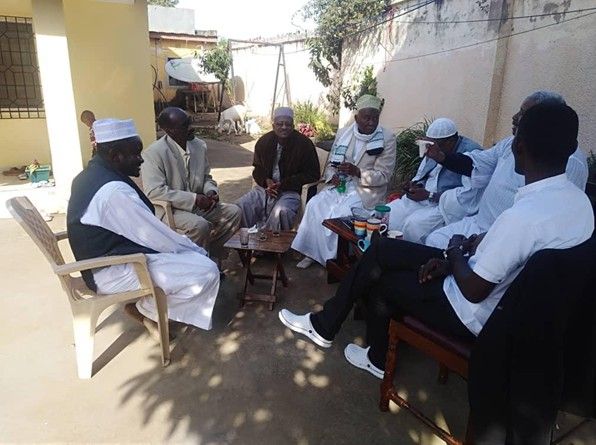
A Eid gathering at Hassan Abddelwahid's House, in Arusha, Tanzania
Ayoub's View
I took the opportunity to ask Ayoub, Uncle Hassan and Aunt Kawthar's son, about being the son of two cultures, two countries, and two rich heritages—not entirely dissimilar, yet each rich with its own past, present, and future.
Ayoub traveled to Sudan at the age of four, where he stayed until finishing his university studies. During which he visited Tanzania for holidays; the longest single interval he spent in Tanzania was between 2019 and 2024. In that sense, Ayoub said that he feels a closer connection to his Sudanese side, culturally, through family, friends, and memories.
Reflecting on the Sudanese Culture, Ayoub mentioned that he values the Islamic religious adherence that is found in Sudan. He enjoys the solidarity and close bonds that make up the Sudanese social fabric, and which he didn’t come across anywhere else in the world.
In Tanzanian culture, he appreciated the independence and responsibility instilled in Tanzanian boys and girls alike; from their early days, they are taught to take care of themselves, and clean after themselves. Additionally, he likes the simplicity with which the Muslim Tanzanians celebrate and organize marriages, encouraging and facilitating the process for their youth, in contrast to Sudan’s more elaborate weddings celebrations.
When I asked Ayoub about the way he sees his Father’s embodiment and representation of Sudan’s good side: the kindness, the hospitality, and generosity, Ayoub brought to the conversation one of the most iconic and long-lasting social concepts in Sudan; “Alwajib” which could be loosely translated to the “the social duty”. In that light, Ayoub sees his father’s comportment towards his Sudanese kin and countrymen and women as a natural manifestation to “being a Sudanese” itself.
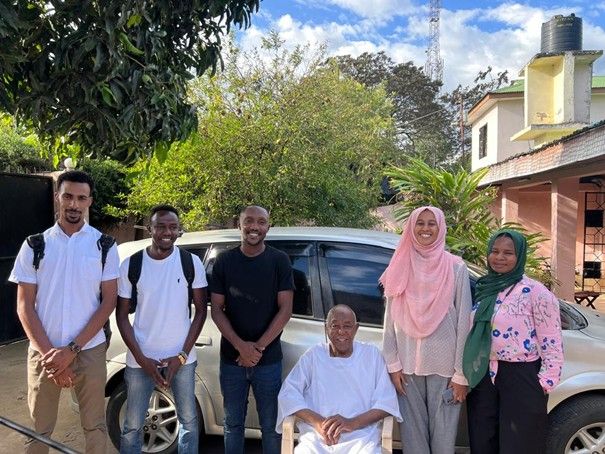
Group photograph at Hassan Abd-Alwahid's House, from Left to right, Yousif Mohammed Zain, Haroun Alsafi, Ayoub Hassan, Hassan Abd-Alwahid, Samah Fawzi, and Roaa Ismail
Uncle Hassan’s Advice to the Sudanese
I ended my interview with Uncle Hassan asking him for advice to the Sudanese people, during these challenging times where we find ourselves scattered across the globe and surviving a conflict, on how to maintain and embody the beautiful Sudanese traits and traditions of solidarity, kindness, and generosity. His advice was both practical and wholesome.
He said that it would be difficult to ask someone to change who they are or to adopt a new behavior right away, but if he could request one thing from the Sudanese people worldwide, it would be "to safeguard the social cohesion and bonds, to not hurt each other, or conspire against one another, to not throw each other to jails, or drag to problems, but to help, protect, and look out for each other."