The effects of shelling and explosions are not the only marks left on a person to remind them of war. There are also psychological and emotional wounds that accompany them; sometimes manifesting in pain deeper than that caused by physical destruction. The impact of the April war in Sudan has extended into the most intimate structure of society: the family. Amid displacement, economic collapse, and a fading sense of security, marital relationships are no longer as resilient as they once were; instead, they have become vulnerable to fracture under the weight of fear, anxiety, and changing living conditions.
This article attempts to unpack the impact of war on marital relationships in Sudan through a sociological lens, supported by insights from mental health specialists, feminist researchers, and testimonies from women and men who have lived through the experience. It also situates the Sudanese case within a comparative context alongside other conflict settings, such as Syria.
Family and War
Sociology views the family as the fundamental unit of society and one of the most important indicators of its cohesion or fragility. The stability of marital relationships cannot be understood in isolation from the surrounding political and economic context; rather, it is shaped by levels of security, patterns of living, and confidence in the future. In societies emerging from conflict, the family is often among the first structures to be shaken, as it sits at the intersection of economic, psychological, and security pressures.
In this context, Musa Idris, a psychologist and researcher in peace studies, explains that the psychological effects of war on social relationships are profoundly deep, driven primarily by two key factors: anxiety and fear. A constant sense of danger makes individuals more withdrawn and less capable of engaging in positive social interaction, leading to an erosion of trust within society- including within the family itself. He adds that this condition makes it extremely difficult to build stable social relationships during wartime, as individuals become more sensitive to everyday tensions, sometimes causing minor disagreements within marriages to escalate.
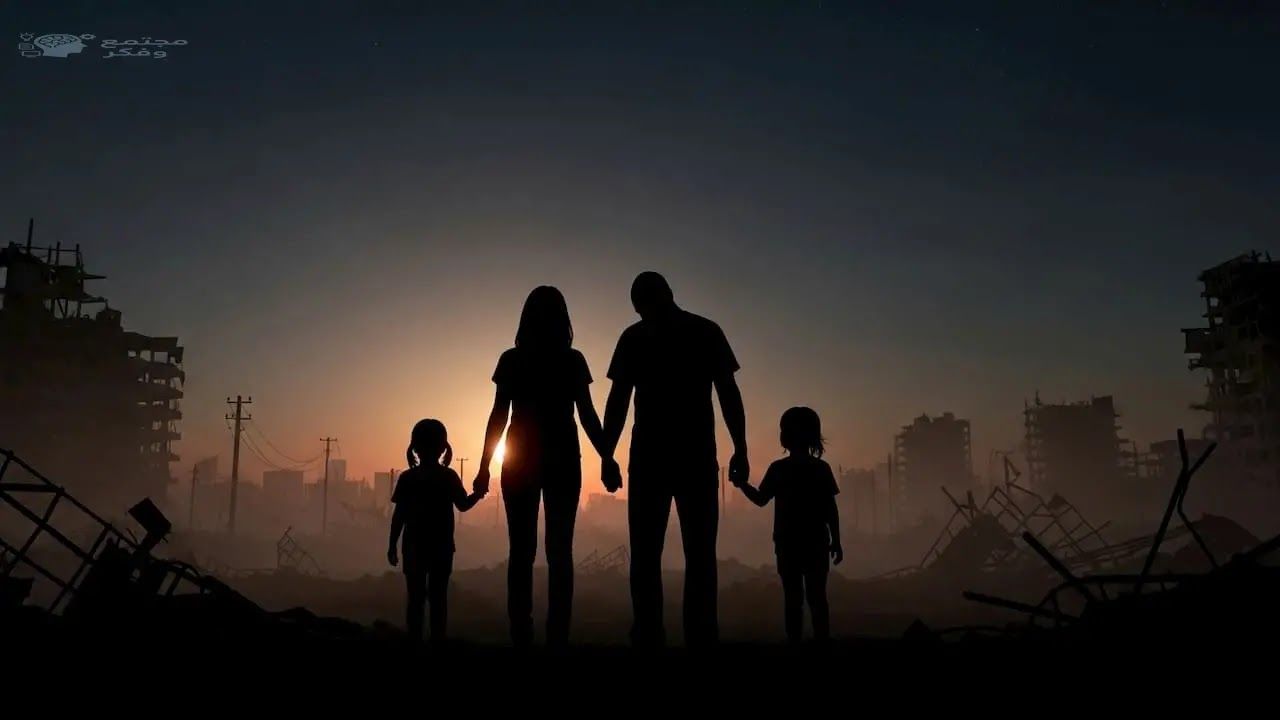
Wars dismantle families, the primary nucleus of society. Source: Mojtamaa Wa Fikr
War in Sudan: a Long History of Conflict
War, in general, is the continuation of politics through non-diplomatic or non-peaceful means, when civil tools fail to contain conflict and disputes are managed through weapons instead of negotiation and dialogue. In such conditions, violence becomes the dominant language, and societies turn into open arenas of loss; loss of life, the erosion of infrastructure, and the collapse of what humanity has built over generations of stability and development. Human history itself can almost be seen as a mirror of conflict; since the earliest forms of human interaction, violence has remained one of the harshest expressions of competition over power and resources.
The Sudanese Context
Throughout its post-independence history, Sudan has suffered from protracted civil wars. The sound of gunfire was absent for only ten years out of the seventy years it has existed as an independent state. The longest of these conflicts was the war in South Sudan with the Sudan People’s Liberation Movement (SPLM), which began in 1983 and ended with the signing of the Comprehensive Peace Agreement (Naivasha) in 2005, after more than 21 years of fighting. The agreement granted South Sudan the right to self-determination, which was realized on July 9, 2011, when it became an independent state and the 193rd member of the United Nations.
However, Sudan soon returned once again to the cycle of war, with the outbreak of armed conflicts in South Kordofan and Blue Nile, and the intensification of the conflict in Darfur. The pace of violence only relatively subsided following the December 2018 revolution and the signing of the Juba Peace Agreement in 2020.
The Impact of War on Families’ Daily Lives
When the current war broke out on April 15, 2023, it struck already fragile communities that had not yet recovered from the effects of previous conflicts. The war led to the displacement of millions of people, a near-total collapse of the economy, and a severe deterioration in basic services, including healthcare and education. According to a World Health Organization statement published on January 9, 2026, more than 20 million people in Sudan are in need of health assistance, while 21 million are experiencing acute food shortages. It is estimated that 33.7 million people will require humanitarian assistance during the same year. The healthcare system has been severely affected, with more than 37% of health facilities out of service. Since the outbreak of the conflict, over 201 attacks on healthcare facilities have been recorded, resulting in 1,858 deaths and 490 injuries.
In the education sector, more than 8 million children have been deprived of their right to education, threatening the loss of an entire generation. UNICEF data indicates that 5 million children have been displaced and have lost contact with schools and teachers. Meanwhile, 6,400 schools have been completely closed, 11% of schools are being used as shelters for displaced people, and one in every three schools is no longer usable due to damage.
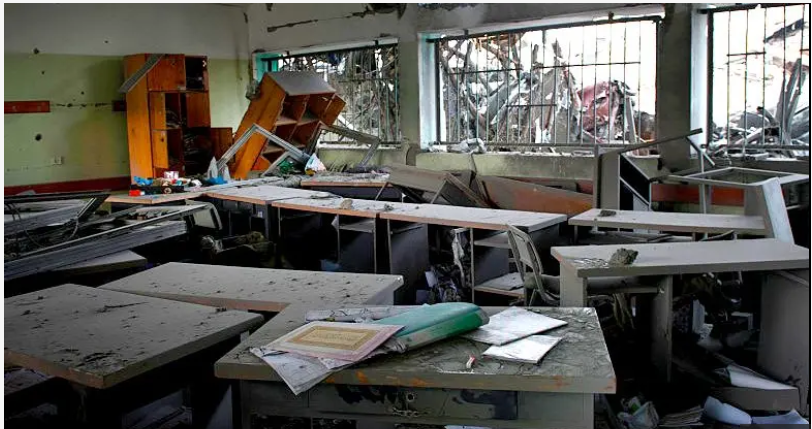
The state of schools during wartime. Source: BBC
These conditions have led to unprecedented waves of displacement and flight. The number of displaced people is estimated at around 13.6 million, including 8.6 million internally displaced persons and 3.8 million refugees in neighboring countries such as Chad, South Sudan, Egypt, Uganda, and Ethiopia.
This structural context of war, combined with all these impacts, has created an environment that is not conducive to family stability. The absence of the state, the disruption of institutions, and the loss of livelihoods have forced families to face their fate alone, without adequate protection networks. As the war has spread into residential neighborhoods, the home, supposed to be a space of safety amid the chaos, has turned into a fragile and threatened place, or even an abandoned one.
In this regard, Musa Idris explains that the prolonged armed conflict in Sudan has left cumulative psychological effects that have worsened with the current war. He notes that these effects were not as visible at the beginning of the war as they are now, but once they reached the family unit and marital relationships, they intensified existing tensions, especially in the context of poverty, job loss, communication breakdowns, and insecurity. As a result, couples have become less able to understand one another and adapt to the new reality, leading to the escalation of minor disagreements into divorce.
Changing Roles Within the Family
Social roles within the family are not fixed over time; rather, they are part of a broader social system that evolves alongside economic and cultural transformations. During prolonged crises such as wars, the traditional roles that family members are accustomed to tend to shift, and economic and social responsibilities are redistributed in new ways. In this context, it is useful to refer to what feminist scholar Srilatha Batliwala presented in her book "Visible, Hidden and Invisible", where she offers a simple and direct definition of power. According to Batliwala, power lies in the ability of individuals or groups to determine: who gets what, who does what, who decides what, and who sets the agenda.
Through these four dimensions, the author moves beyond the conventional understanding of power as merely control over material resources or the public sphere. She also examines how these dynamics shape the distribution of opportunities and labor, not only in paid productive work, but also in the sphere of social reproduction, including domestic work, childcare, cooking, fetching water, and other everyday activities that sustain family life.
Based on research and fieldwork conducted for this article, it was observed that many cases of displacement and refuge caused by the war have led to noticeable shifts in these roles. Many women have taken on greater economic responsibilities than they had before the war. These roles are closely tied to questions of power within the family: who works, who manages resources, and who makes decisions about how they are used.
In this sense, the shift in economic provision within the family can be understood as a transformation in the very structure of power itself, particularly in relation to control over work and its organization. However, these changes do not always occur smoothly; they can sometimes create new tensions within marital relationships or within the family more broadly, especially when combined with the psychological pressures imposed by war, loss of stability, and the sense of helplessness that some men may experience as a result of losing their traditional economic roles.
The Case of Souad Hosni
The experience of Souad Hosni (a pseudonym), a Sudanese refugee in Egypt and a mother of three, illustrates how these shifts can affect marital life. Before the war, Souad worked as a kindergarten teacher in Omdurman and contributed to household expenses, while her husband worked in the police before later becoming a cook. However, after the family arrived in Egypt, roles gradually changed, with Souad becoming the primary breadwinner. At the same time, her husband began sending a large portion of his income to his family in Sudan. As Souad’s three sisters moved in to live with them, daily conflicts between the couple escalated, eventually ending in separation and divorce.
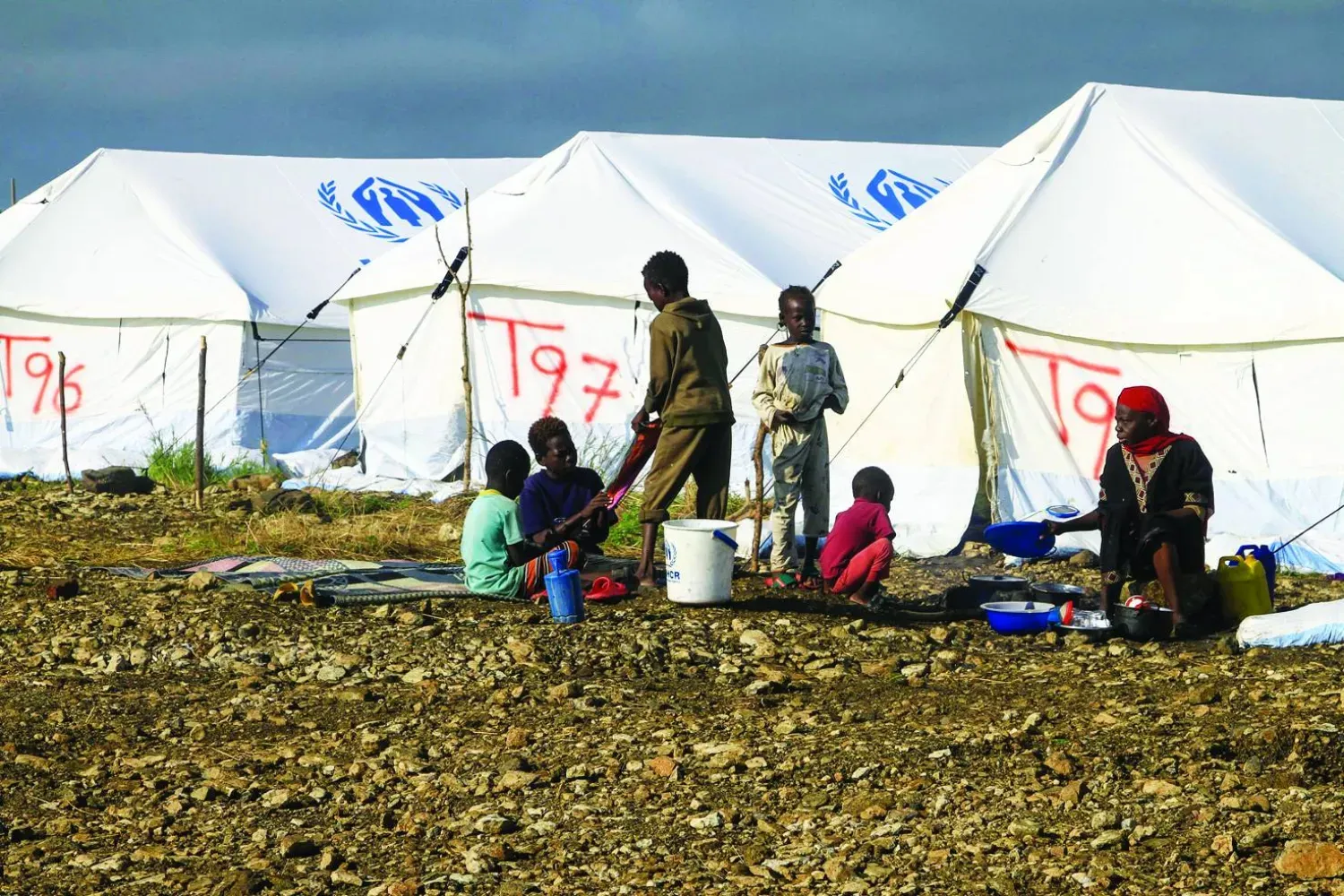
War and displacement destabilize families. Source: UNICEF
Divorce in Times of War
Testimonies from Sudanese civil society organizations indicate a noticeable rise in divorce rates during the years of war. Although obtaining precise statistics is difficult due to institutional disruption and displacement, the general trend reflects a clear increase in family breakdown, particularly in cities directly affected by the war and in areas of displacement and refuge.
According to the Lubna Organization for Development and Community Studies, divorce cases in Sudan rose to around 96,000 cases in 2023, marking a 36% increase compared to previous years. The organization also reported that Sudan witnesses around 11 divorces per hour and more than 8,000 cases per month. It attributes this phenomenon to a combination of factors, most notably economic pressures, domestic violence, deteriorating mental health, shifting gender roles, and displacement, which often forces multiple families to share the same living space.
Shared Housing and Loss of Privacy
Among the factors that have emerged during the war is the issue of shared housing. As the fighting spread, large numbers of families were forced to leave their homes and move to areas considered relatively safer. In this new reality, many displaced people found themselves facing two limited options: either having the financial ability to rent a new home in the cities they moved to, something that was not available to many due to rising rents and loss of income, or seeking refuge in relatives’ homes in villages, rural areas, or cities less affected by the war.
As a result, many houses turned into shared living spaces accommodating more than one family at the same time. Entire families moved in with their extended families, such as parents, siblings, or other relatives. In some cases, a single house came to host three or four families sharing the same spaces and limited facilities. Although this pattern of living provided a form of family solidarity during wartime, it also created additional pressures in daily family life, especially for couples who lost their usual privacy and found themselves living within an extended family network where everyday details became intertwined.
Maryam’s experience clearly illustrates this situation. Maryam Suleiman (a pseudonym) says that she and her husband fled their home in Al-Haj Yousif during the first month of the war to her husband’s family home in the city of Al-Duweim in White Nile State. As the house became crowded with more than three families, conflicts between her and her husband escalated, especially after she asked to move to a separate home. The situation ended in intense arguments and a prolonged dispute that ultimately led to divorce, an option that, as she describes it, had not been considered before the war.

The need for some families to live as displaced people in schools has led to the breakdown of some relationships. Source: Independent Arabia
Researcher and feminist Rahma Jaber believes there is a significant difference between a couple living independently and living with their extended family, whether with the wife’s or the husband’s relatives, as this is closely tied to privacy. In Sudan, there is limited privacy, as social overlap is strong, even in the smallest details of married life, which makes things difficult for couples and strips them of their personal space.
She added that the issue, for her, is fundamentally about privacy. In the family home, couples lose this privacy, not because families do not respect it, but because this is the nature of the society. As a result, living conditions become difficult for them.
She also noted that Sudanese people tend to be very talkative, which does not support stable relationships. Women, in particular, often demand separate housing, as this simply allows them greater comfort and enables them to manage the household more effectively than when living with an extended family. Shared living also imposes additional responsibilities on them, even in matters that may seem simple, such as cooking, which becomes a daily task except in cases of illness. For these reasons, women tend to prefer living in separate homes.
Displacement and Refuge: Additional Pressures on Relationships
In cases of prolonged displacement or seeking refuge outside the country, pressures on family relationships intensify.
Marafi Mirghani (a pseudonym) left Sudan for South Sudan, and then moved on to Uganda, where she arrived in October 2024 with her husband and two children, while leaving four children behind, her husband’s children from a previous marriage, who stayed with their grandmother in Kosti, Sudan.
Marafi recounts her story: “I used to work in Sudan as a cook at Khartoum Airport for about four to five years. I was supporting the household, and the home we lived in belonged to me. When we arrived in Uganda, I was initially ill, and my husband was unemployed. We received limited support from an organization at first, which helped somewhat."
She continued "After I recovered, I started making incense (bukhoor) inside the camp and sending it to be sold in Kampala. Later, I began thinking about bringing my four children from Sudan, but my husband refused, saying he was not working and could not afford additional expenses."
She recalls discussing the matter with him again, but he still refused. In January 2025, she brought the children anyway and enrolled them in school upon arrival. At first, they stayed in school accommodation, but during the holidays, when they came to live with her, the problems between her and her husband increased. He had been opposed to the idea from the beginning.
She said "The tensions and arguments escalated because of the children, until he gave me an ultimatum, him or them. I chose my children, and we divorced a few months ago.”
Marafi’s experience reveals one aspect of the transformations imposed by the war on family life, where women, in many cases of displacement, have taken on greater economic responsibilities.
Women as Breadwinners in Times of War
The war has affected patterns of economic provision and altered care-giving and spending roles within the family, especially in contexts of displacement and refuge. Women have increasingly become the primary breadwinners, particularly as most displaced people and refugees are women and children. Meanwhile, men have either joined armed groups or remained behind to protect their homes.
As a result, women in places of refuge have taken on multiple roles. In addition to responsibilities of provision, care-giving, and upbringing, they have assumed new economic roles. Women who previously worked lost their jobs and were forced to take on new types of work, unrelated to their previous professions. Even those who had not worked before are now compelled to engage in small, often informal activities to meet basic needs during displacement and to maintain family cohesion.
Khalda noted that these responsibilities are in addition to caring for and educating children, as well as looking after the elderly and the sick. All of these duties now fall on women alongside their new economic roles. She added that these roles demonstrate women’s ability to make meaningful contributions to the economy and economic life more broadly.
Khalda argues that this reality should be reflected after the war through new policies that support women and enable them to continue these economic roles. This includes providing childcare support, such as paid maternity leave and workplace childcare facilities, with state support.
In contrast, Rahma Jaber holds a different view. She says: “I do not believe that the shift to women as breadwinners has occurred completely, in the sense that women have become the sole providers. This has not happened entirely. Women have always been providers and have played significant and diverse roles in supporting their families, but the war has made this more visible. When men were working in state jobs, the war disrupted these jobs, and they ended up staying at home. With men less present in this role, the image of women as providers became more apparent. In other words, the war did not create this role, it simply made it more visible.”
Comparison with the Syrian Case
The Syrian case offers an important point of comparison. Social reports have shown a rise in divorce rates during the years of war, particularly in the early stages of the conflict. According to statistics from the Syrian Central Bureau of Statistics for 2024, the divorce rate reached 12.4%, an increase of 11% compared to 2021. In 2022, 46,827 divorce cases were recorded compared to 225,549 marriages.
The data also shows that Damascus recorded the highest divorce rates at 33.9%, followed by Rural Damascus (Rif Dimashq) (30.9%), As-Suwayda (30%), Quneitra (29.9%), Latakia (28.7%), Daraa (26.1%), Tartus (23.3%), Homs (23.2%), Hama (22.4%), and Aleppo (20.1%), while Idlib, Deir ez-Zor, Al-Hasakah, and Raqqa recorded the lowest rates.
Between Two Cases: Similarities and Differences
The causes in both the Syrian and Sudanese cases are similar: economic collapse, displacement, loss of the breadwinner, and psychological trauma. However, the Syrian experience also showed a decline in marriage rates, unlike the Sudanese case, where rising divorce rates have coincided with an increase in marriages, alongside a growing phenomenon of child marriage in the absence of state structures.
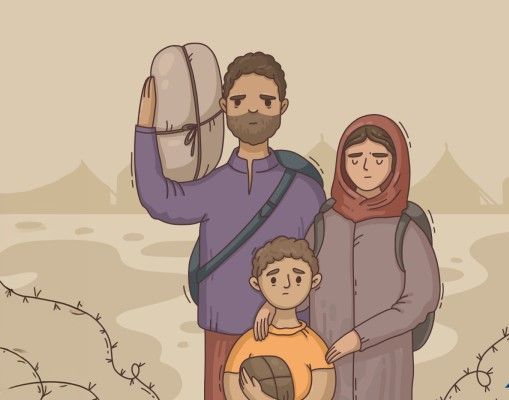
Instability is wreaking havoc on family stability. Source: Hakini.net
In March 2021, Sudan’s judiciary issued statistics indicating 7 divorces per hour, bringing the annual total to over 60,000 cases.
In May 2022, official statistics from the Sudanese judiciary showed that between 2016 and 2020, a total of 270,876 divorce cases were recorded, distributed as follows:
48,351 in 2016,
55,478 in 2017,
59,339 in 2018,
60,202 in 2019,
and 47,506 in 2020,
This is excluding cases that were not brought before the courts.
Rahma Jaber, a researcher and feminist, says that after returning to Sudan last year, she observed the extent to which the war had affected divorce rates. She noted that while divorce rates increased, marriage rates also rose. She even asked a marriage registrar about this trend.
During her time in her area, she observed that some couples separated while others did not. She believes that, in that context, it was sometimes better for women to remain with their husbands. Despite the risks men faced, such as arrest or death, their presence provided a degree of safety during long displacement journeys marked by hunger and insecurity.
Although women were often solely responsible for providing food during that period, they still needed men for protection and companionship along the way.
At the same time, she pointed out that some women left on their own and managed to travel long distances on foot during displacement until they reached safety.
What Do These Transformations Mean?
These testimonies and analyses show that war affects not only the economy or security but also extends deep into the structure of social relationships. Marital relationships, which are supposed to be a source of stability, can instead become spaces that reflect the economic and psychological pressures experienced by society.
At the same time, communities are trying to find new ways to cope with these changes. Since mid-last year, new forms of social response have begun to emerge. Accounts on platforms such as TikTok and YouTube now offer content on marital relationships and managing family conflicts. Some individuals present themselves as “relationship therapists” or social advisors, filling the gap left by traditional social institutions during the war.
Although this phenomenon is still in its early stages, it reflects society’s attempt to develop new tools to deal with the transformations affecting family life.
Among Sudanese communities in the diaspora, particularly in Uganda, which hosts an estimated 80,000 or more Sudanese refugees, various organizations and initiatives are working to provide support in this context. One of the leading organizations held more than three workshops for Sudanese participants on social support and organized a seminar with relationship expert Magdi Ezzeldin in December.
Conclusion
The war in Sudan reveals a complex relationship between conflict and family disintegration. Economic, psychological, and social crises intersect to undermine the stability of marital relationships.
Comparisons with other experiences, such as Syria, show that the family is often among the first and most affected victims of war. At the same time, these transformations raise deeper questions about the future shape of the family, the roles of women and men within it, and the role of the state in rebuilding social protection systems after the war.
As noted at the beginning of this article, it is not only the effects of shelling and explosions that leave their mark on people. There are also psychological and emotional wounds that accompany them, sometimes manifesting as pain even deeper than physical destruction.
