Trigger Warning and Disclaimer: The following content includes personal and sensitive experiences. The views expressed are those of the author and do not necessarily reflect the positions of Andariya. We encourage you to engage with the piece in whatever way feels right for you. You can read our full editorial notice here.
A text I write after leaving Kordofan… and leaving with it the last vestiges of my homeland
From Omdurman to the roots: a departure I never anticipated
I never imagined I would one day leave Omdurman against my will, dragging behind me a heart pierced by a bleeding homeland. Leaving in July 2023 was a nightmare that swallowed all sense of safety and extinguished every light along the roads. The sound of gunfire forced me to leave, but I did not know then that the destination would be more than just a place- but a return to the roots, to Kordofan.
The journey felt like walking on the thorns of memory. Every kilometre that pulled me farther from the capital distanced me from a life I knew and drew me closer to another I had never imagined. Yet something along the way began to change. At first, I thought it was only a temporary stop, a refuge for a while.
But something in the soil of Kordofan changed me.
It was not a destination, but a return, to a root deeper than I had thought.
My Kordofan was waiting for me, not to remind me of what I had lost, but to tell me that the land knows how to mend a broken heart.

The breathtaking nature of Kordofan. Source: Facebook
From memory to collective action
In Kordofan, culture was not a luxury; it was a tool of resistance and rebuilding. The "Kordofan Mobile Library" project, launched by a group of young volunteers in 2023, was not merely about transporting books, it was a bridge between past and future.
Sara Ahmed, the project coordinator, says: “We used to move the books between villages in a donkey-drawn cart, and suddenly the library turned into a space for storytelling and learning. Children learned to read letters, and elders shared stories from the past. Culture became a collective act that resists oblivion.”
Kordofan… Sudan in a small mirror
At the heart of Sudan’s geography, Kordofan rests with the steadiness of mountains and the tranquillity of plains. A region often called “miniature Sudan,” not only because of its location, but because it reflects the country’s entire diversity: its north in El-Obeid, its south in Kadugli, and its west in Al-Fula. Kordofan resembles no other place, and never resembles itself twice.
It embraces a rich diversity of languages and local dialects, forming a distinctive ethnic and cultural mosaic. This diversity is especially evident in social occasions. At weddings, for example, Baggara songs blend with Nuba rhythms, and dishes like kisra and molokhia are served as symbols of coexistence and unity among the tribes.
Bara… When memory dances beneath the lemon trees
Bara was my first stop. Its road is enchanting; its trees sway as if welcoming me with ancient songs. As we passed along the Bara road, the trees waited for us like longtime friends. Suddenly, memory knocked on the door of the heart with a song by Abdel Gadir Salim, the renowned singer from Kordofan, who tragically passed away on December 16th 2025:
“Bara’s lemons, brothers, chant the jalala,
Glory be to God Almighty,
And the envious one, his eye is deceitful.”
A song that embraces the earth with the rhythm of feet. With it, memory rises, and bodies of young men sway as if reviving clay and air. Pure Kordofani heritage, where dance is ritual, song has identity, and the land has a voice.

Entrance to the city of Bara. Source: Facebook
El-Obeid… where the land speaks the language of trade and scent
Then there was El-Obeid…
A city that needs no guide to understand it. It is enough to wander its market under the rain, or to pause at a ful (fava bean) stall where Umm Dalal jokes with her customers. When we entered El-Obeid, I felt as though I were stepping into a heart that never stops beating.
El-Obeid is not only the gum Arabic exchange, nor merely trade routes, nor the oil pipeline stretching toward Port Sudan as is said. It is a city where life is lived through the senses rather than logic, through details rather than statistics. El-Obeid’s market is not just a place of buying and selling, but a space of cultural and social exchange. From braided cheese to gum Arabic and sidr honey, every corner tells the story of a land that never betrays its generosity.
Even amid war, the market has maintained its economic role, as FEWS NET reports indicate. El-Obeid is a city that heals itself despite its wounds.
Ahmed, a ful seller, says:
“This market is a witness to everything, wars, celebrations, and the coffee we drink together, even if we are strangers.”

Wad ‘Akeifa Market, El-Obeid. Source: Facebook
Kordofan: from the womb of suffering, creativity is born
Migration and displacement, both internal and external, have not severed people's connection to Kordofan; rather, they have strengthened it. In displacement camps around El-Obeid, women have formed groups to make "jerkiz" and traditional jewelry, selling them through online platforms. Umayma, one of the displaced women, says:
“We don’t just make products, we are creating a memory. Every piece tells the story of a woman from Kordofan.”
Even Kordofan’s diaspora in the Gulf and Europe have founded the Voice of Kordofan Initiative, which documents traditional songs and stories and supports small cultural projects. Khalid, an engineer and one of the initiative’s founders, says: “Migration made us realize the value of our heritage even more. We are now working on a digital archive for all of Kordofan’s heritage.”
Al-Nuhud… a city that forged its glory without a railway
In Al-Nuhud, the first impression was not immediately clear. A city bustling with movement, noisy at times, enigmatic at others. But with time, I began to see in it features that resemble us all: the stubbornness of cities that forge their own paths, a memory etched into stories, and people who know how to turn hardship into narrative. A city that does not wait for a train, but makes its way on foot. From the stones of Manqar Manqar, to the pool of "Nadi al-Salam" Al-Salam Club, from beneath the shade of the baobab to the mouth of the legend of Jadd Hamar, the city told its own story.
Al-Nuhud is a city that breathes dust and preserves memory. Whoever wishes to know it should read the book of Haj Salem Ibn "Saq' al-Jamal", written as prayers of loyalty are written. Al-Haj Omar recounts in his book The Memory of Al-Nuhud how residents of diverse backgrounds used to gather every Friday at Al-Salam Club to read poetry and tell stories, and how these gatherings later became a platform for solidarity in times of crisis.
Kordofan weddings… when joy takes ritual form
If you wish to see joy embodied, attend a Kordofani wedding. Here, the wedding is a collective ritual: from bridal trousseau, adorned with women’s tenderness, to henna that decorates hands with grandmothers’ prayers; from the traditional wedding procession to the wedding ceremony. Then comes the qadaḥ: a gier porridge with eggs and money, presented to the bride’s mother as a symbol of generosity. One of the most beautiful scenes is the building of the house of al-shiqāq, made of palm fronds, wool, and wood, adorned with beads, leather, and cowrie shells, to serve as the bridal chamber. A custom still alive among the Baggara, Shanabla, Dar Hamid, and Hamar tribes. This is joy not created for cameras, but created by souls.

The wedding house is designed specifically for newlyweds. Source: Facebook
The life of the Baggara… a journey like a painting
The Baggara are known less as a tribe than as a way of life. Their seasonal journey begins after the first "rashāsh" rains, with small families stretching across the land like a single painting. The scent of rain in Dungusu, facing storms with small tents, the taste of of kashit stew after rain, and drinking bātil amid the hambareeb "cool breathe", all are details that keep memory alive. At night, dobayt poetry rises, the kita is played, and cold mashish water is sipped. The herders return carrying the forest’s gifts: iblila, jaqjaq, and babanus. They return as one body, undivided by distance or altered by circumstances.
In Kordofan, women and hakamat play a prominent role in social life, using songs as a space to convey messages of peace between tribes. Sufi dhikr circles beneath trees have also become arenas for dialogue among youth. FAO notes that the Baggara represent a living model of resource management through traditional knowledge. Time for them is not measured in hours, but in rain, in the taste of kashit, and in the glow of fire on pastoral nights.

Nomadic Baggara. Source: Facebook
Al-Fula… as told by uncles’ stories
I never physically reached Al-Fula, but I visited it in conversation, during evening gatherings, in my uncle’s stories, in my other uncle’s laughter as he spoke of his childhood in the fields. I saw Al-Fula through their eyes: an agricultural city, strong, warm, growing cotton and hibiscus, and growing in its people an unbreakable resilience. They said it had gold and oil, but they did not speak of that much. They spoke of weddings, coexistence, and people, as if Al-Fula wasn't resources, but a soul.
A city inhabited by grain, melodies, and tribes. Peanuts, millet, hibiscus, even cotton, all planted by hand and watered with hope. Beneath the ground lie oil, gold, and gum; upon it live people who know how to turn coexistence into law, and land into a mother.
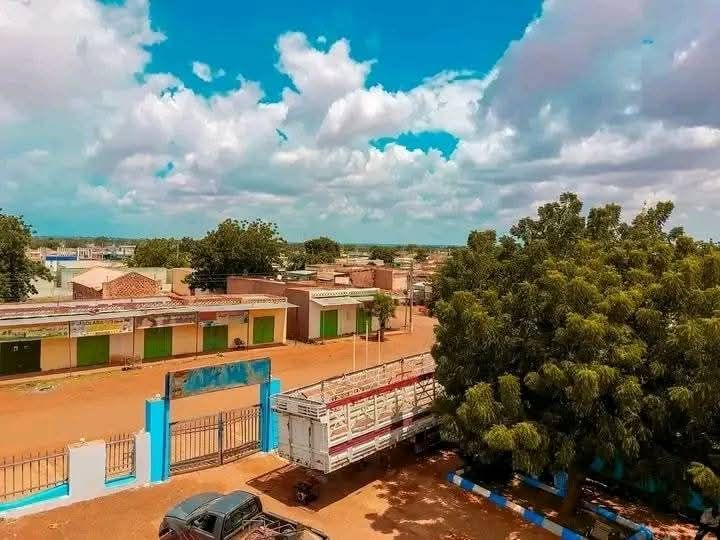
Al-Fula city. Source: Facebook
Lagawa… the city that breathes gently
As for Lagawa, it was the city I longed for before seeing. Its stories resemble chants, light, repetitive, sincere. In the shade of mountains, between the murmur of the seasonal stream, and in people’s names, Lagawa took shape in my imagination. They said it does not shout, does not adorn itself, but it is real. As if it teaches you silence, attentiveness, and calm. There, at the edge of the hills and beneath the mountains’ shade, Lagawa stretches like a city contemplating life. Beyond the murmur of the seasonal khor, the pulse of simple markets, and names etched in memory, Lagawa forms itself. It does not shout. It does not embellish. It is content simply to be: quiet, patient, and true. Today, more than 70% of its schools are damaged or closed, according to UNICEF reports.
Kordofan Between the Light of Memory and the Darkness of War
According to UNESCO reports (2023), efforts to protect intangible cultural heritage in Sudan are aimed specifically at strengthening community resilience, particularly among youth affected by conflict. The organization has emphasized that focusing on heritage constitutes a crucial pillar for reinforcing social cohesion and confronting ongoing challenges. Culture, then, was not a luxury, it was a weapon against forgetting.

In addition to the beauty of its stunning landscapes, Laqawa is known for the unity of its people. Source: Facebook
The Kordofan we once knew was a tale of light: Bara dancing to the rhythm of lemons, El-Obeid telling its stories to history, and Al-Nuhud singing beneath the shade of baobab trees. But the war, this war that began in Khartoum and then spread, found in Kordofan a land rich with life and turned it into yet another theatre of destruction. In June 2025, El-Obeid, the capital of North Kordofan, became a target of drone attacks when the Rapid Support Forces launched a sudden assault that terrified residents and struck at the heart of the city. Since then, El-Obeid was no longer just a marketplace of stories; it became an open battlefield.
To the west, in Al-Nuhud, where children once played with sticks beneath baobab trees, fierce fighting erupted between the army and the Rapid Support Forces. The innocence of cities was assassinated; homes were shelled, mosques destroyed, families displaced. A city built by dreams rather than railways seemed to be dimming its light piece by piece, screaming in silence that enough was enough.
Al-Fula, land of gold and oil, Bileila, Al-Zarqa, and Abu Jabra, was turned into spoils contested by both sides, while the roads leading to it became corridors of fear. The Rapid Support Forces seized strategic garrisons, and the Western Al-Inqaz Road became a contested artery between those seeking control and those defending the country’s last remaining pulse.
The conflict destroyed part of the region’s agriculture, as the World Food Programme has noted, yet it did not extinguish the farmers’ resilience. Al-Fula will not die. It is like the land itself, it knows when to swallow tears and when to sprout an ear of grain beneath them. The war did not stop at bombardment; it penetrated everything: from sesame and peanut farms to school halls and rural health centers, from the dreams of young girls in Lagawa to the steadfast souls of mothers in Babanusa. Even the oil fields, once relied upon to revive the economy, became vulnerable to damage and shutdown amid media absence and global indifference.
Yet Kordofan, as we have always known it, does not surrender.
Kordofan… Between Memory and the Future
In Kordofan, the past is not told merely as remembrance, it is practiced as life. In hardship, men gather around pots of ‘asida, sharing food and words alike. Through joudiyya, nafeer, and faz‘a, community strength is built. In herding, weddings, and markets, the meaning of belonging takes shape. Even the war, despite all it has stolen, could not steal the Kordofani song, nor the ululations of women, nor the land’s insistence on giving.
As affirmed by the academic study “Folk Heritage and Its Role in Strengthening Cultural Identity… Kordofan” (2018):
“Kordofani heritage is valuable, distinctive, and diverse, and constitutes a strategic resource for supporting national identity and contributing to cultural development and advancement.”
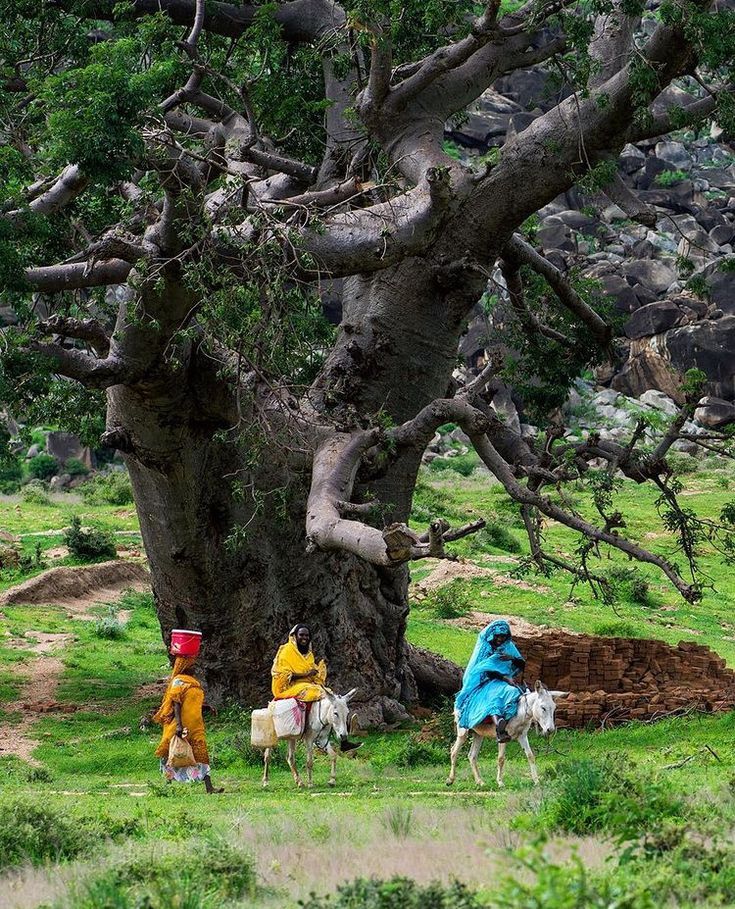
The daily commute of some residents. Source: Pinterest
Then I left… yet I did not leave
When I was forced to leave again, this time beyond Sudan, I departed physically, but something of my soul remained there. I began to follow Kordofan’s news from afar. Al-Nuhud, where we once drank coffee, became a headline in a sorrowful news bulletin. Al-Fula, which I knew through stories, is now bombed. Lagawa, which I never saw but which lived inside me, suffers in silence. They became the final meaning of a homeland that lives within us, even when we leave it.
It is El-Obeid that taught me the senses; Bara that returned memory to me; Al-Nuhud that opened the door of belonging; Al-Fula that I carried through the stories of loved ones; and Lagawa that I planted in imagination.
I did not write this text while I was there. I wrote it when I realized that Kordofan is still within me, even after I left. Perhaps some cities are not written merely to be told, but to awaken restless questions within us: Who are we when we are forced to leave? And where do we return when imagination itself is bombed?
If you have passed through Kordofan, or if it has passed through you, give its memory a voice. Write about it, or read, or ask, or remember. For some places do not heal from us unless we remember them out loud.
Editor's note:
Since mid-2025, Kordofan has witnessed a marked escalation in violence as fighting between the Sudanese Armed Forces and the Rapid Support Forces intensified and expanded across North, South, and West Kordofan. From late 2025 into early 2026, cities including El-Obeid, Al-Nuhud, Al-Fula, Lagawa, and surrounding rural areas have been affected by airstrikes, ground clashes, and attacks on civilian infrastructure. Markets, roads, health facilities, schools, and agricultural areas have sustained damage, further disrupting daily life and essential services.
According to the United Nations and humanitarian coordination mechanisms, the conflict has compounded an already dire economic and humanitarian situation. Supply routes have been repeatedly cut, prices of food and fuel have soared, and access to healthcare, education, and clean water has deteriorated. Large numbers of civilians have been displaced within Kordofan or forced to move onward, while those who remain face increasing food insecurity and limited humanitarian assistance due to insecurity and access constraints.
This article is published amid these ongoing developments, as Kordofan continues to endure escalating violence, deepening humanitarian needs, and widespread uncertainty, even as its communities struggle to preserve social cohesion, culture, and resilience under extraordinary pressure.