Not losing God. Questioning who's been collecting on His behalf.
A generation is untangling belief from prosperity gospel, imported guilt, and pastoral authority.

Mama Ngina Street, Nairobi. The city where a quieter, more personal shift in faith is taking place. One street, one household, one Sunday morning at a time. Photo by ClaraTowett
About a year ago, Mother gave a sacrifice at our local church. It was money, given the way our churches teach: as an act that moves God's hand. The same day, after three years of joblessness, I got an offer.
I want to be honest about what that did to me. It felt like proof. Not coincidence. Proof. Three years of silence, and then this, on the exact day.
Six months later, I lost the job. When I mentioned it to our pastor, she didn't skip a beat: what is begotten by sacrifice must be sustained by sacrifice. I hadn't kept giving. I hadn't kept the account open.
I sat with that explanation longer than I want to admit. Long enough to wonder what kind of God runs a ledger: deposits in, blessings out, service suspended on missed payment. Long enough to notice that this wasn't really a question about God at all. It was a question about the church I'd inherited, and whether the God it described was the God I actually believed in.
That question is not mine alone. Across Nairobi and beyond, a generation raised inside near-obligatory church attendance is quietly stepping back from the pews, not toward atheism, but toward something else. This is not the Western story of millennials leaving faith behind. It's a different, more specific story: of a generation disentangling God from the institution that has long claimed to be the only place to find Him.
Blessing Comes With an Invoice
What happened to me and to Mother isn't a fluke, or a uniquely unkind pastor. It's the operating logic of a specific religious economy. Kenya sits near the center of it.
In a 2006 Pew Forum survey, 85 percent of Kenyan Pentecostals said God grants material prosperity to all believers who have enough faith. Zoom out to sub-Saharan Africa broadly, and more than half of Christians across most countries surveyed hold the same belief: that God will grant wealth and good health to people with sufficient faith. This isn't a fringe theology whispered in a handful of tent revivals. It's closer to the regional default setting.
Once that belief takes hold, giving stops being an act of devotion and starts functioning like a transaction: sacrifice in, blessing out. And when the blessing doesn't arrive, or worse, arrives and then vanishes, the system has a built-in explanation ready. You must not have sustained it. The deposit lapsed. Renew your subscription.
It's worth naming what's actually happening in the moment the "blessing" seems to land. A job offer that surfaces after years of unemployment, on the same day as a financial sacrifice, feels like causation. Psychologists have a name for why: confirmation bias, the tendency to seek and interpret evidence in ways that flatter a belief we're already holding. It's a bias so pervasive across human reasoning that researchers consider it one of the best-documented forms of inferential error in the field.
There's a second, quieter statistical trick working alongside it. A stretch of extreme hardship (unemployment stretching past the two-year mark, say) is, on its own, more likely to be followed by improvement than by more of the same; extremes rarely sustain themselves. Statisticians call this regression to the mean, and it means the very worst chapters of a person's life are disproportionately likely to be followed by something better, with or without a sacrifice at the altar. None of this makes the relief less real. It just means the ledger explaining it was drawn up after the fact, not before.
The Ledger Was Never God's

St. Peter's Cathedral in Nyeri, Kenya. Showing how religious institutions shape towns and communities across the nation. Photo by Lucrez Same
Scholars who study African Pentecostal finance have been circling this dynamic for two decades, mostly under less forgiving names. Sociologist Asonzeh Ukah, who has built a career examining the finances of West Africa's largest megachurches, has repeatedly pointed to what he calls a "sacred secrecy" surrounding church finances. That opacity, not incidentally, makes it very difficult for any single giver to ever confirm whether their sacrifice bought them anything at all. The ledger only ever runs one direction: legible to the person asking for the deposit, illegible to the person making it.
This is the part that turns a personal disappointment into a structural critique. It isn't that one pastor was unusually harsh. It's that an entire model (call it Cosmic Compliance Culture: an HR file for the soul, tithes as pay stubs, sacrifice as renewal fee) depends on giving remaining continuous and faith remaining measured in receipts. A God who blesses unconditionally is much harder to monetize than a God who requires an active subscription.
And the population living inside this model skews remarkably young. Kenya is a remarkably youthful country: the median age is 19, and about 80 percent of the population is under 35. Which means the friction between an inherited transactional theology and a generation increasingly unwilling to accept it isn't a subplot. It's close to the main story.
A God Who Arrived Already Gendered
The transactional model has a mirror image: a theology that arrived in Kenya already dressed in someone else's authority.
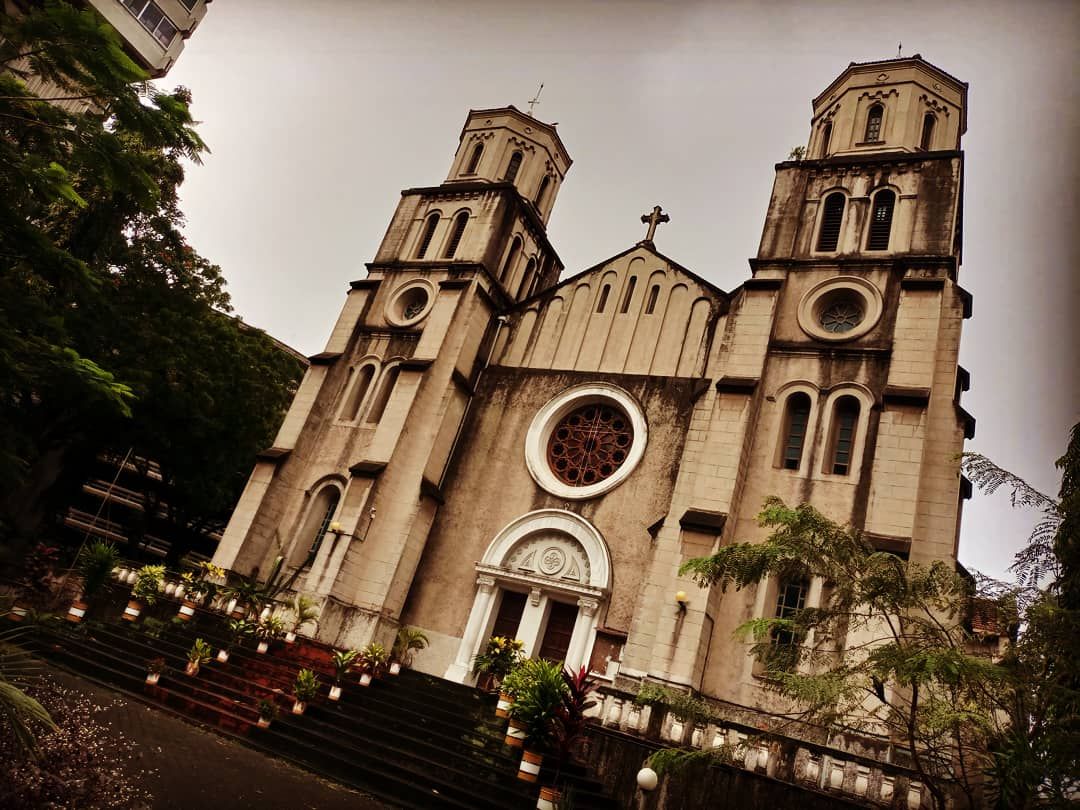
Holy Ghost Cathedral, Mombasa, completed in 1923 under the Spiritan missionary order. Kenya's Christian institutions arrived, and were built, under colonial administration, and continue to shape what the faith demands of believers today. Photo by By Linda Wairuri Gichohi
Kenyan theologian John Mbiti wrote his career against a specific colonial claim: that Africans had no religion at all before missionaries arrived, only superstition waiting to be corrected. His countering thesis, distilled into one of his most cited lines, was that wherever the African is, there is religion. His larger argument against what he called "imported Christianity" wasn't that missionaries brought something false. It's that they brought something foreign, dressed it as universal, and taught converts to be suspicious of their own inherited frameworks for meeting the sacred. Guilt, punishment, and compliance became the operating system.
It would be a stretch to say that the system invented patriarchy. It didn't. Pre-colonial African Traditional Religion was, by most scholarly accounts, already patterned on a male-imaged Supreme Being, even where female divinities existed alongside it. What colonial Christianity added wasn't gender hierarchy itself, but a specific kind of rigidity around it: formal, ordained, exclusively male clergy structures that replaced the more varied ritual roles (diviner, healer, mystic) that women had held, however peripherally, in indigenous religious life. It took an existing hierarchy and sealed it into doctrine, backed by eternal stakes.
"But Some Churches Are Led by Women"
That doctrinal sealing survives the obvious objection, that some Kenyan churches are, in fact, led by women. Doctrine and leadership are not the same axis. The same 2006 Pew survey that measured prosperity beliefs also asked Kenyan Pentecostals whether a wife must always obey her husband. Sixty-five percent completely agreed. Another twenty percent mostly agreed. Eighty-five percent combined agreement, in the same country, the same survey, among a population that includes women in leadership roles of its own.
A congregation can have a woman in the pulpit and still inherit a theology where God is exclusively "He," "Father," "King," and where that grammar quietly legitimizes male headship as the unquestioned norm everywhere else in the institution, from the household to the boardroom.
Kenyan scholar Damaris Parsitau, who has spent years studying Pentecostal women's leadership in Nairobi churches, describes Kenyan women's position within these structures as that of "sub-oppressors": participants who sustain a system that limits them, not for lack of agency, but because the theological architecture around them was built to go unquestioned. Writing separately in The Elephant, Parsitau put the enforcement mechanism plainly. Theological and cultural justification, "it is written," "it is our culture," is routinely deployed to explain away the church's treatment of women, reinforcing male headship as doctrine rather than custom.
Scripture itself doesn't require this reading. The Amplified Bible's rendering of Genesis 1:27 states that God created humanity in His own image, then immediately specifies that image as both male and female. A translator's note in the same chapter clarifies that "image" refers to spiritual personality and moral likeness, not a literal, gendered body. The text leaves room for a God who isn't reducible to one gender. Centuries of translation, preaching, and institutional convenience settled on "He" anyway, and treated it as fact rather than convention.
So when Kenyan millennials start asking why God has to be a "He," or start refusing pastoral authority that polices their choices in God's name, these are not two separate rebellions. They're one. Questioning the gender of the Divine and questioning the unquestionable authority of the person claiming to speak for Him are the same act of unbraiding. It's one system, pulled apart at two points at once, regardless of who's currently standing at the pulpit.
No Mediator Required
There's a sociological term for what's happening underneath all of this, and it predates smartphones, prosperity gospel, and Nairobi altogether.
A 2022 study of lapsed-Christian young adults in Nairobi, baptized, raised Christian, now secular or spiritually unaffiliated, found a pattern that research elsewhere has given a name to. British sociologist Grace Davie called it "believing without belonging" in 1994: religious belief persisting even as institutional participation collapses. The Nairobi data suggests this was never a peculiarly British phenomenon being exported. It's what shows up, independently, in the interview transcripts of Kenyan twenty- to thirty-somethings explaining why they stopped attending church years before they stopped believing in God. The two, it turns out, were never as fused as churches liked to claim. People can walk away from the building without walking away from the belief. That's a more precise diagnosis than "millennials are lazy" or "millennials don't believe in anything." The pattern isn't disbelief. It's declining patience for the gap between what an institution preaches and how it behaves.

For a growing number of Nairobi's millennials, the search for meaning increasingly happens away from the pew. Photo by AEira-WMF
If patriarchal authority is one form the middleman takes, produced worship is another. In Nairobi specifically, the institutional church experience has, for a generation raised inside Pentecostal and charismatic worship, become highly produced: sound systems, lighting design, a pastor at a pulpit, a worship team trained to build toward a specific emotional climax. None of this makes the worship insincere. But it does mean the dominant model of "meeting God" in urban Kenyan Christianity has, for many, become a mediated one, engineered as much as it is felt.
Stepping back from that model isn't the same as stepping back from God. For a growing number of millennials, it's closer to the opposite: a suspicion that a curated, amplified experience might not be the most reliable place to find something real. If institutional worship has become a produced event, then quiet, actual, unmediated, unscheduled quiet, starts to look less like the absence of spiritual life and more like a precondition for it. You don't need a pastor, a pew, or a sound engineer to sit with a feeling long enough to know if it's true. You need the discipline to sit in silence without reaching for a screen, a sermon, or a stage.
Not Less Spiritual, Just Less Willing to Outsource Spirituality
There's a generational dimension to this too, one that's measurable beyond Kenya. A 2026 Edelman survey of Gen Z found family (88 percent) and friends (84 percent) named as top sources of trust and inspiration, against just 44 percent for religious leaders and 42 percent for politicians. It's worth being precise about what that erosion actually targets. A 2016 survey of Kenyan youth by the Aga Khan University found religious organizations to be the second most trusted institution nationally, at 86 percent, behind only family.
So the decline isn't in trusting religion as a category. It's in trusting the specific chain of pastoral mediation, the pulpit as the only sanctioned channel to God, that this piece has been describing. Kenyan millennials aren't becoming less spiritual. They're becoming less willing to outsource where and how that spirituality gets to happen.
This is the throughline connecting everything so far. The transactional-faith system requires an institution as the middleman between a person and their blessing. The patriarchal-authority system requires an institution as the middleman between a person and God's voice. And the produced-worship system requires an institution as the middleman between a person and their own spiritual experience. Millennials disengaging from Sunday service aren't rejecting three unrelated things. They're rejecting one thing, three times: the claim that God is only reachable through an intermediary.
The Story's Own Ending
Middleman between a person and their blessing. Middleman between a person and God's voice. Middleman between a person and their own spiritual experience. The same obstruction, three times over, and the tradition these millennials are accused of abandoning already addresses this obstruction, in its own ending.
Christian eschatology's own end point isn't more institution. It's less. Revelation 21 and 22, echoing Isaiah's vision of renewed heavens and a renewed earth, don't describe believers escaping to a disembodied heaven administered by clergy. They describe heaven coming down to a restored, physical earth. And in the final image of that restored city, John writes: "I saw no temple in it, for the Lord God Almighty, the Omnipotent, the Ruler of all, and the Lamb are its temple". No sanctuary required.
No priesthood required. No structure required. Presence only. Biblical scholar N.T. Wright, in his widely read work on Christian hope, reads this as the culmination of a consistent theme: renewal of the old creation, not replacement of it. The world made whole. Read plainly, the vision at the very end of the Christian story is a world with no building left standing between a person and God.
That's not a fringe reading invented to justify skipping church. It's sitting in the text millennials grew up being handed. The very text this generation is accused of abandoning. Which means the shift this piece has traced (away from the pew, the pulpit, the produced worship set, the tithe-as-subscription) isn't a rebellion against Christian faith's own logic. It's arguably a rough, early, imperfect gesture toward where that logic was always headed: a faith that doesn't need a mediator, a blessing that doesn't need a toll booth, a voice that doesn't need an interpreter, an experience that doesn't need a stage, and finally, an eternity that doesn't need a temple. Because the thing the mediator was standing in for was never actually far away.
None of this erases the real cost of the shift. Community gets harder to find outside a building built for exactly that purpose. Grief, celebration, accountability: these are easier with people around a table than with a person alone in quiet. The critique this piece has made is not an argument for isolation. It's an argument for relocating trust: from an institution that too often required payment, patriarchy, and performance, to a God who (if the tradition's own ending is to be believed) was never asking for a toll booth in the first place.
Where Does That Spiritual Life Happen Now, If Not in a Pew?
For me, most days, it’s a passage of scripture, read slowly, checked against two or three interpretations I didn't grow up being offered, and a conclusion I'm allowed to sit with rather than one handed to me pre-approved. Other days it's meditation, where I sit in quiet reflection.
Interviewing young adults in Nairobi who'd stepped back from Christian practice, researchers Selvam and Githinji found a similar pattern: connection relocated, it didn’t disappear. One participant, Mary, 34, describing herself as a Christian who is not religious but is spiritual, put it almost exactly this way: connection to a higher power, reached however feels right, without a building, a service, or an organization required to get there. Others in the same study described the shift as refusing to keep performing belief, not leaving it behind. Sustained questioning became its own kind of practice, and a personal, reciprocity-based ethic (do to others what you'd want done to you) replaced doctrine as the operating moral compass.
None of this looks like a church. It’s more the absence of church being filled with something quieter and harder to institutionalize: a meditation practice, a private conviction, a refusal to perform faith for anyone's benefit but one's own.
I still think about that sacrifice, and the job, and the ledger I was handed to explain both. I no longer think God kept that ledger. I think a system did. It was built long before I was born, out of colonial guilt, borrowed patriarchy, and a theology that runs better on fear than on trust.
I don't know, still, exactly what happened the day I got that job, or the day I lost it. I've made peace with not knowing. What I do know is that the God I'm rebuilding a relationship with doesn't require me to know. He (or She, or whatever word survives translation) was never running a subscription service. That was a system wearing God's name. So no, stepping away from Sunday service didn't mean I gave up on God. It meant I finally started looking for Him somewhere the ledger couldn't reach.