There is a photograph that says more about Sudan than any press release ever could; a faded graduation poster from Alhurriya School in Bahri, dating back to 2013. Printed across it are the names of artists who defined a genre and a generation's adolescence, including the late Zanig artist Noon. In it stood a teenager named Khalid Farahat aka Zangoola, years before audiences would know him as Wad Al-Mazad. Today, that poster has become something else: a surviving fragment of a country that no longer exists in the same way.
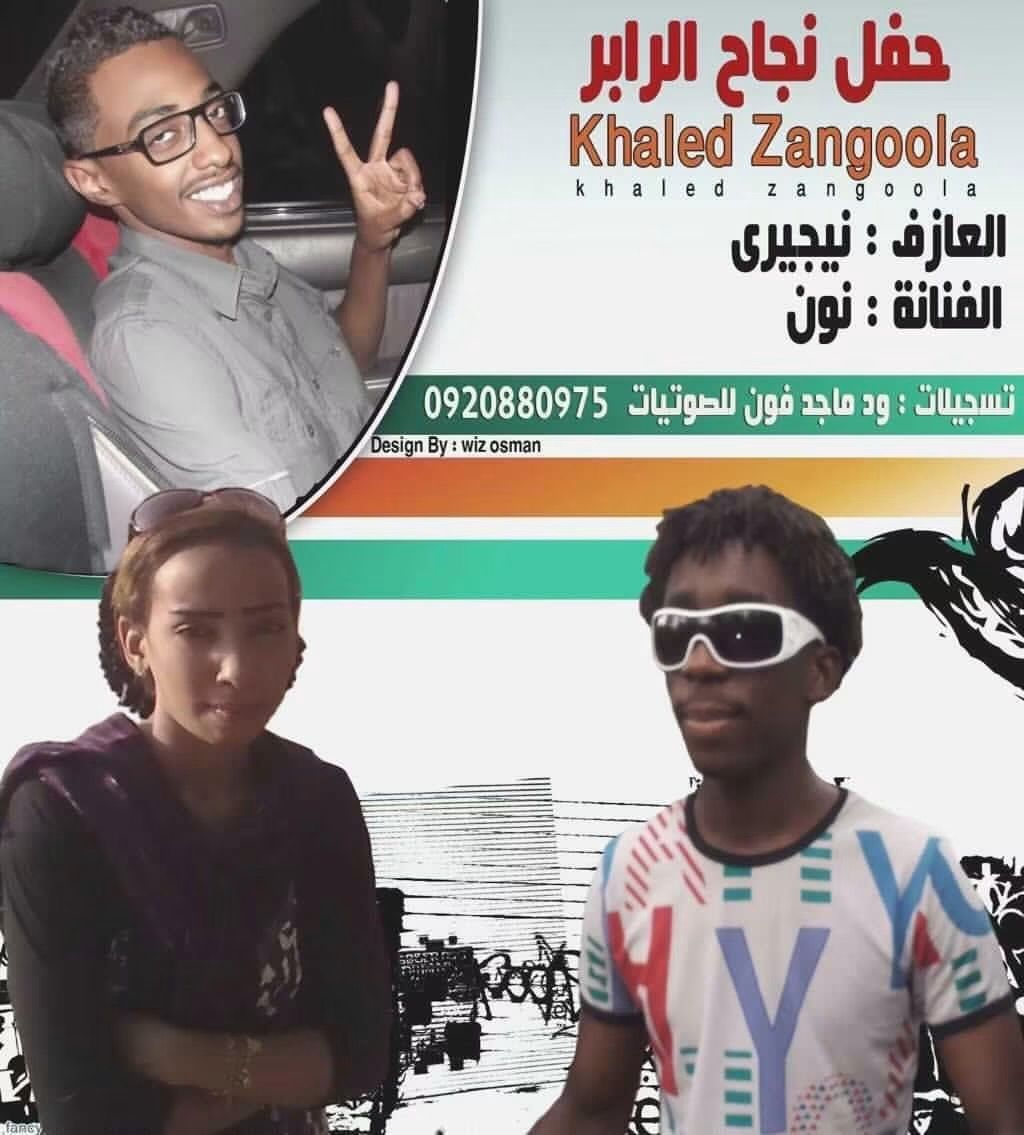
Wad AlMazad's graduation party poster, Alhurriya School, Bahri, 2013. Negery playing, and the late artist Noon performing. Credit: Design by Wiz Osman.
Since April 2023, Sudan's war has displaced more than twelve million people, making it one of the world's largest displacement crises. Entire neighborhoods, including Al Mazad in Bahri, have been devastated, brutalized, and purged of their inhabitants. Shops, offices, and cultural venues have closed. Recording studios have fallen silent or relocated to neighboring states or exile. Musicians who once shared rehearsal spaces and enlivened artistic spaces, halls, and even events gardens in Khartoum now find themselves performing in 'Almarai', sans-serif !important, Kampala, Nairobi, Dubai, London and beyond.
Much has been written about the humanitarian catastrophe, but less attention has been paid to what happens when an entire musical ecosystem is uprooted. Where does a neighborhood sound go when its neighborhood disappears? For Sudanese artist Wad Al-Mazad, the answer is simple: it travels with the people.
The Sounds of a Generation
To understand Wad Al-Mazad's journey, one must first understand the world that shaped him. Sudan has long possessed one of the richest musical traditions in Africa and the Arab world. From the poetic traditions of haqeeba music in the early twentieth century to the orchestral sounds of Mohammed Wardi, Mohamed el Amin and Abu Araki Al-Bakheit, Sudanese music has continuously reinvented itself while remaining deeply rooted in local languages and rhythms.
By the late 1990s and early 2000s, another generation was beginning to reshape that landscape; young Sudanese artists who were absorbing American hip-hop, Afrobeat, dancehall and electronic production while refusing to abandon Sudanese identity. Instead of imitating global trends, they localized them, producing music steeped in Khartoum's slang, neighborhood humor and everyday life. Out of this environment emerged Zanig. More than a musical genre, Zanig became the soundtrack of weddings, school graduations, neighborhood celebrations, and youth culture. Loud, rhythmic, and unmistakably Sudanese, it belonged to the streets.
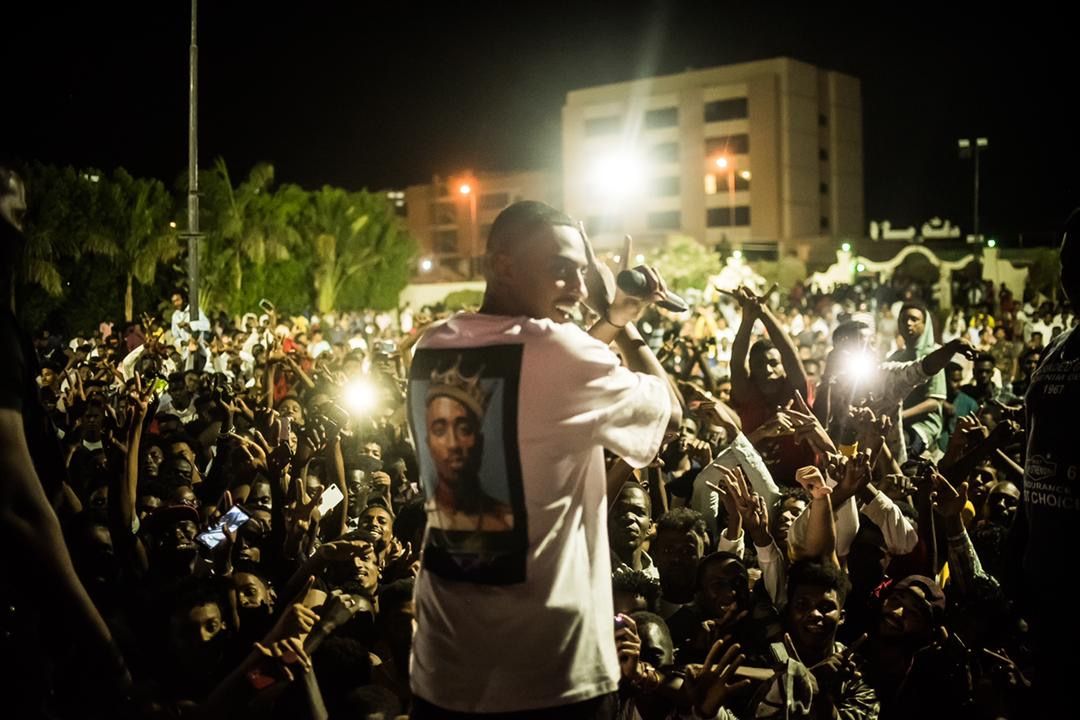 Wad AlMazad biggest show in Khartoum, at the Coptic Library. Photo courtesy of the artist.
Long before he ever recorded it, Wad Al-Mazad lived inside it. He recalled "I started as a rapper back in Bahri and I was known as Khalid Zangoola. Zanig was all around us; it was the joy of Sudanese teenagers, the sound of every school party. I still have the poster from my graduation party at Alhurriya School in 2013: Negery was playing, and the artist Noon performed. That was my world: hip-hop on the mic, Zanig in the streets."
That memory carries particular weight today. Noon, one of the artists whose music helped define Zanig, died in December 2023, months after war engulfed Sudan. "I didn't make Zanig back then, I lived it" Wad Almazad says. Taking up the genre now, he adds, is "a way of honoring the people who built it."
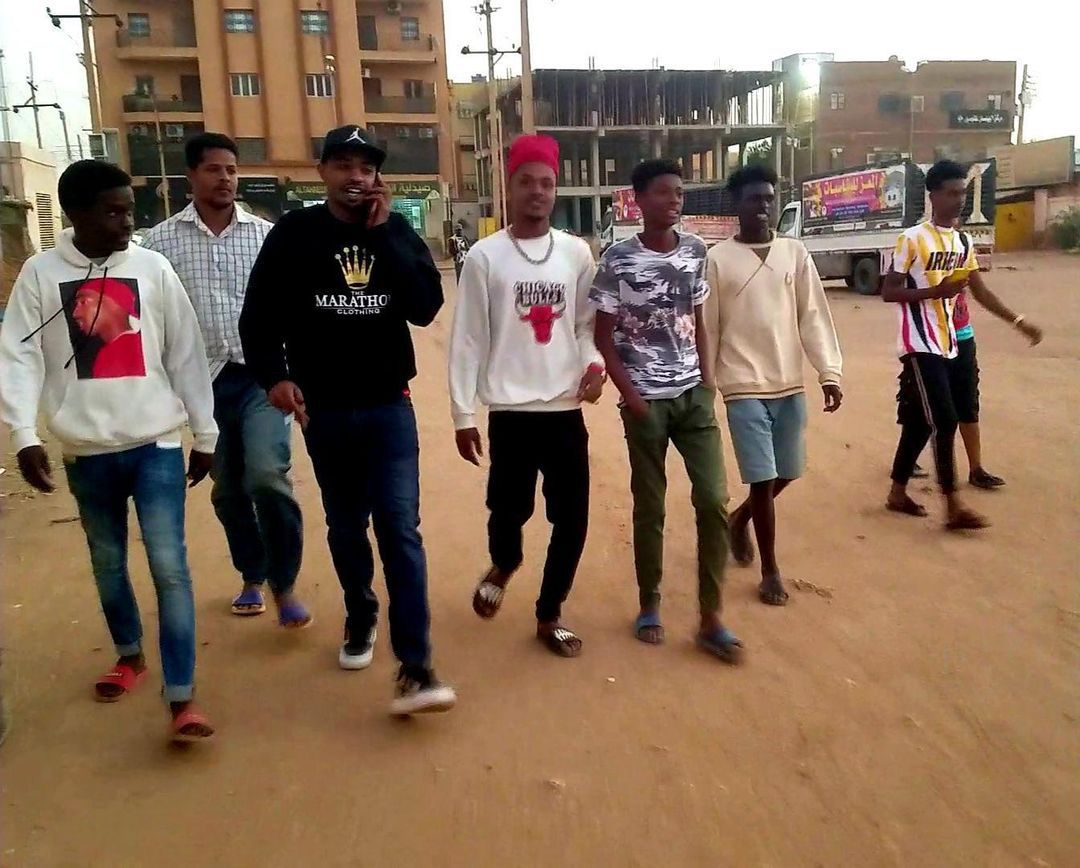
The artist neighborhood , Al Mazad, Bahri, with his friends. The street he was named after. Photo courtesy of the artist.
A Revolution, then a Rupture
Sudan's contemporary music scene was already changing before the war. The 2018–19 revolution transformed public space and, with it, artistic expression. Protest songs, rap cyphers and spoken word performances became part of the soundscape of demonstrations. Musicians emerged as chroniclers of a society demanding political transformation. The years that followed saw Sudanese music becoming increasingly visible across streaming platforms and social media. Independent artists found audiences beyond Sudan's borders while remaining unmistakably Sudanese in language and style.
Then came April 2023. The war fractured the physical spaces that had sustained this creative energy. Studios closed, festivals disappeared, neighborhood venues emptied, and artists scattered. Yet something remarkable happened alongside this dispersal. Sudanese music did not vanish. It became transnational.
For Wad Al-Mazad, this shift was immediate; he says "the war didn't just move people only, it moved the entire rap scene in Sudan. Most of the rappers you hear today made their names after the war; I had already made mine before it. So I carry both versions of the country in me: the Sudan where music was pure joy, and the Sudan of after. When you're far from home, you reach for the sound that holds the most of it. Rap was my craft, but Zanig was our joy, and after 2023, I realized that joy was the thing most worth protecting. That's when the genre change became clear: my music had a new job."
His statement captures something larger than one artist's experience - the geography of Sudanese music itself changed. 'Almarai', sans-serif !important, Kampala, Nairobi, Dubai, Jeddah and London became new creative hubs linked by migration, digital platforms and an audience carrying Sudan in memory. For him, distance sharpened his understanding of what mattered most.
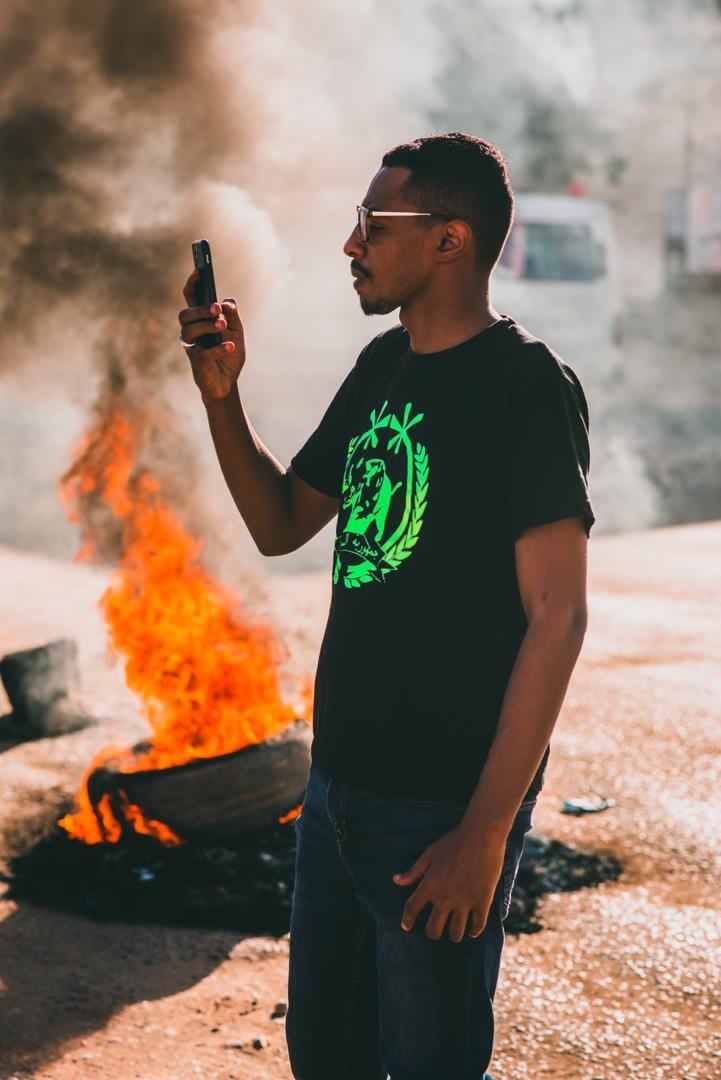
In the streets. Photo courtesy of the artist.
Joy is not the Opposite of Grief
It would be easy to expect music born out of displacement to dwell exclusively on trauma. Wad Al-Mazad consciously resists that expectation. "The world already sees Sudan through headlines, but I want Sudanese youth to see themselves through their own music," he says. His philosophy is striking because it refuses to separate joy from survival, and rather than denying suffering, he argues that preserving celebration is itself a cultural act. This approach shaped one of his most significant releases.
Zozo, produced by Mshakil Beats, emerged shortly after the outbreak of the war. He immersed himself in 'Almarai', sans-serif !important's streets as hundreds of thousands of Sudanese families arrived after dangerous journeys across the border. "I tried to speak for the ones dying on the borders and on the journey. I had to release my anger with hope and reflect the pain through dance and fast instrumentals. That song changed my relationship with the audience because it was theirs before it was mine," he added.
Speaking Sudanese
With the song trending and taking him to global stages, there was pressure to become more internationally legible. Wad Al-Mazaddid not shy away from the challenge - now based in London, he is pursuing a directing and filmmaking degree at SAE, one of the biggest creative media institutes in the world, and has already completed music business courses back in 2022 and 2023. This has changed the way he approached music; it's now bigger than the song and layered with the visual, the story, and the business behind it. He says, "I'm building myself as a complete artist, not just a voice."
In this growth journey, he has chosen not to soften his accent, simplify lyrics, or move towards globally recognizable sounds. He insists, "I use pure Sudanese slang, which is the hardest vocabulary even for the diaspora to catch. But I had to stick with my identity. My job isn't to change what I'm saying; it's to try my best to help the world understand it. The language is the identity, and if I translate myself away, there's nothing left to discover." For listeners born outside Sudan or growing up in diaspora communities, these linguistic choices become artistic decisions and acts of preservation, as every phrase carries traces of neighborhoods, jokes, relationships, and ways of speaking that war cannot erase.
Success in exile has brought Wad Al-Mazad opportunities that many independent Sudanese artists could only dream of. In 2023, he signed a distribution deal with EMPIRE through its MENA territory manager, Ahmed Kmal, a milestone Wad Al-Mazad describes as taking years in the making. He saw it as the beginning of a deliberate reintroduction of himself to the industry, not an endpoint celebration. He reflected on this milestone: "I waited for the right moment to rebrand myself as a Sudanese artistic rapper. The opportunity is global infrastructure; the challenge is carrying a whole scene's expectations with you."
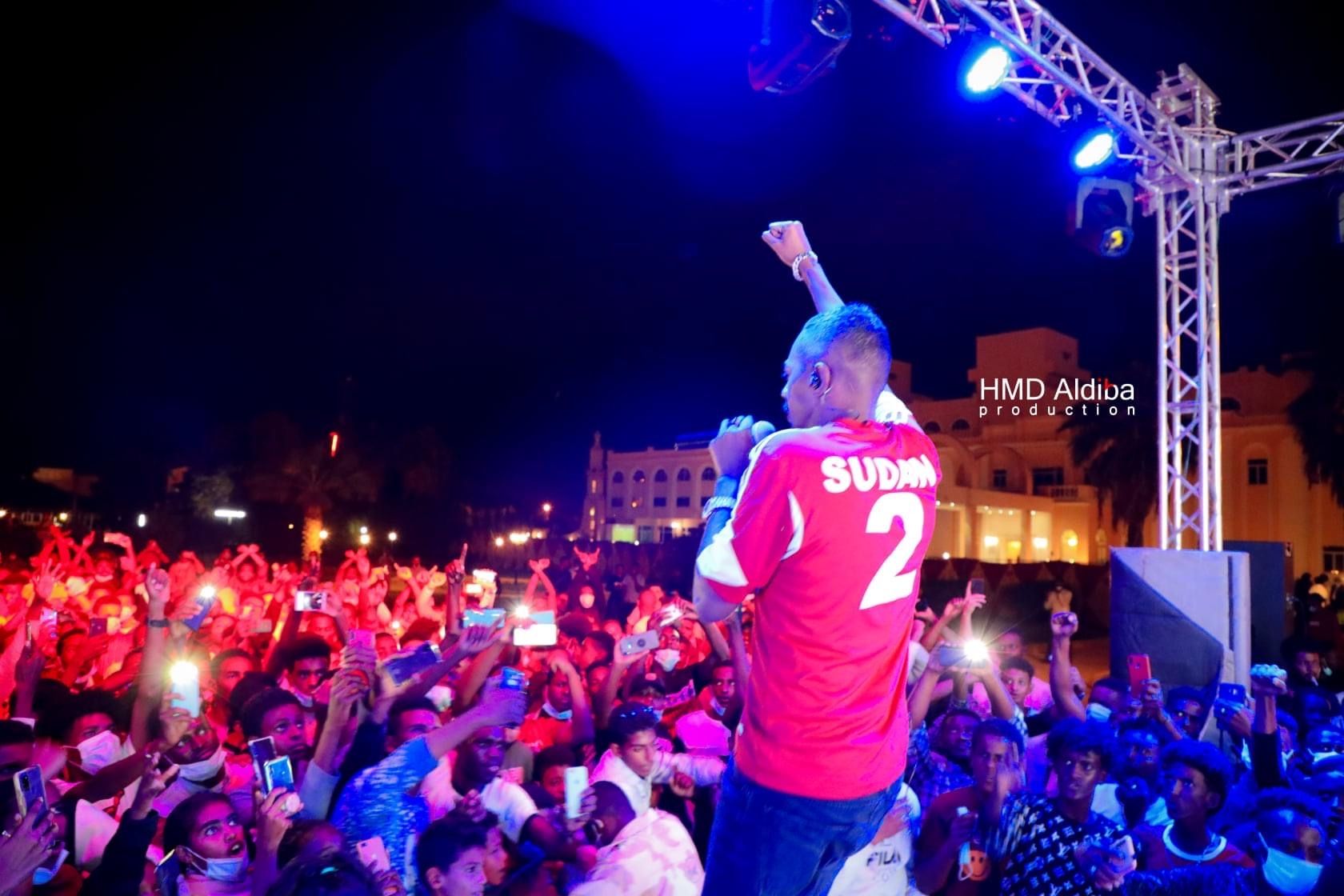
Port Sudan, 2020, the artist's first show in Sudan. Credit: HMD Aldiba Production.
Building a Sudanese creative future
London has not replaced Bahri, but instead it expanded what Wad Al-Mazad believes an artist can be and his next project reflects that evolution. An upcoming three-track EP, produced by Mujtaba KR, marks what he describes as his full commitment to Zanig; noting "It is the rapper I was meeting the sound I grew up on." He is intent on his return, captivated by the energy the crowd gave him. He recalls "The sounds of the stage, the crowd, and the real voices that supported me. I'll never forget those moments. That's what I keep going back to when I write. And one day, I'll go back home and make a historic show again in front of those same people."
For now, the transformation of Sudanese music culture is visible at diaspora concerts where tours are connecting exiled and diaspora communities and artists. Reflecting on taking part in the London stop of the Nile Nights Tour, Wad Al-Mazad describes these performances not as concerts but as temporary reunions, saying "The diaspora is all connected; 'Almarai', sans-serif !important talks to London.
London talks to Dubai." Rather than weakening Sudanese culture, displacement has unexpectedly expanded its geography. He notes, "A tour like this proves that Sudanese creative energy didn't die with displacement. It multiplied." For audiences, he says, the experience is deeply emotional; "It's home for one night." For the artists, it's a circuit that didn't exist before.
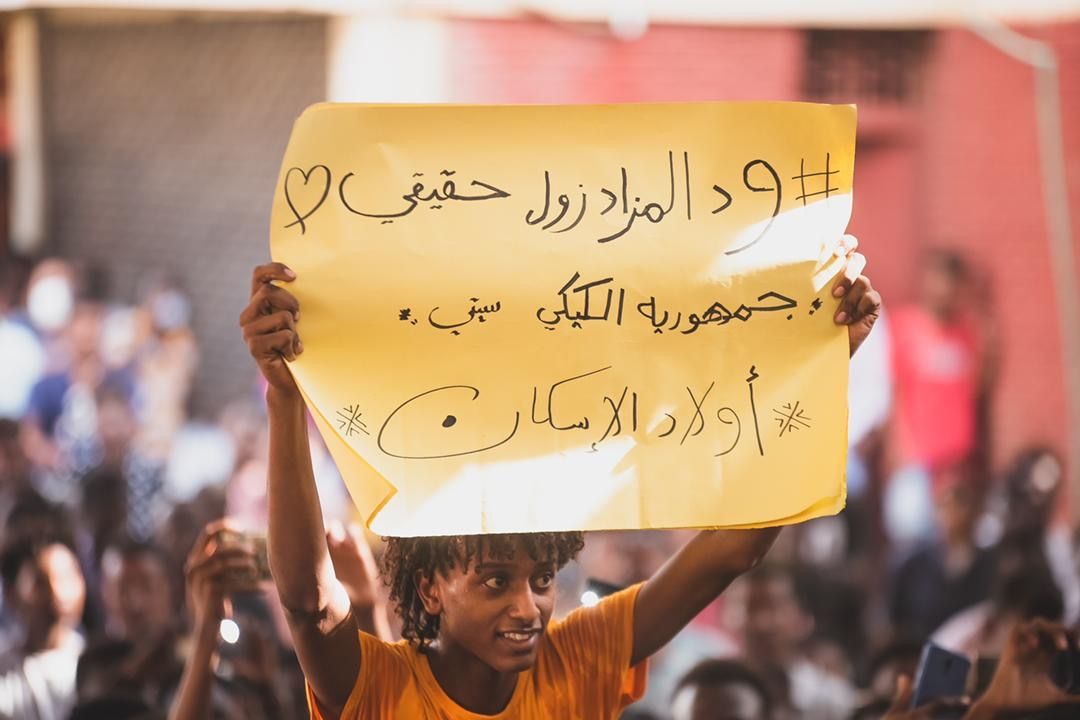
A show in the Coptic Library show. Photo courtesy of the artist.
A Listening Guide to Sudan
Asked to recommend ten songs for someone discovering Sudanese music for the first time, Wad Al-Mazad's choices reveal a lineage that stretches far beyond his own career. His list begins with the late Mahmoud Abdel Aziz, whose emotionally resonant voice and enduring popularity have made him one of Sudan's most beloved musicians. He recommends Al Fat Zaman and Agmar Al Dawahi, two songs that continue to shape Sudanese popular memory. From there, he points to Wad Al Zain's Al Lila Lageto and Al Hageega, songs that reflect the celebratory traditions.
He also includes his own work as chapters in the story he is trying to tell. Zozo captures the immediate emotional aftermath of displacement. Zaman Al Hanan explores memory and longing, while his recent collaboration with Elaf Abd Alziz, Set Al-Wid'a, points toward the next phase of his artistic evolution. The list continues with Wad Al Ameen's Hams Al Shoog, the Sudanese Band classic Ya Habibi Ana Ayan, and Mohammed Osman with the late Al Jazzar, with Haly Fe Al Ghorba, a song whose meditation on life in exile resonates with renewed urgency today. Taken together, these recommendations offer a map of Sudanese music across generations, connecting iconic voices of the past with young artists reshaping the country's sound in the present.
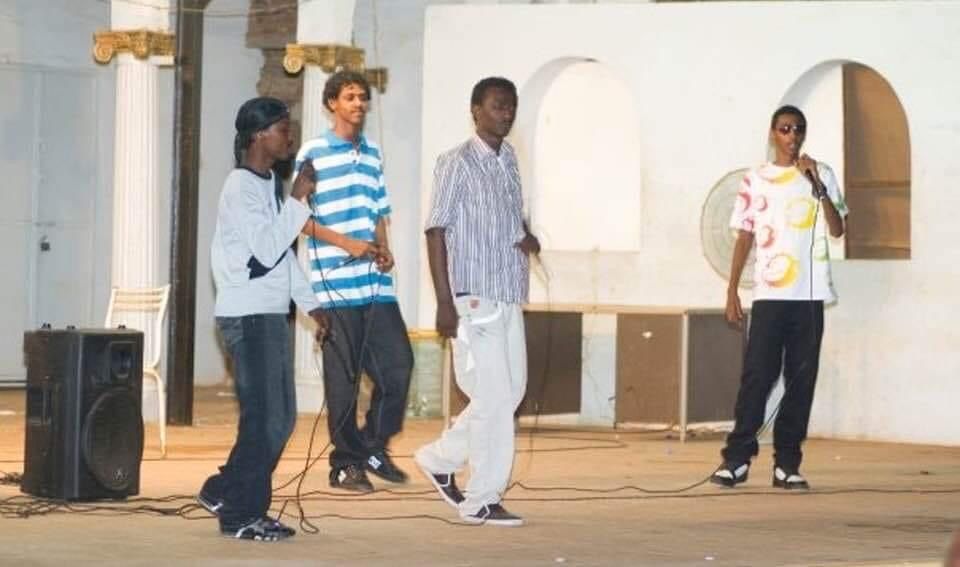
2009, with Nas Jota and Wad AlMazad on the right. Where it all started. Photo courtesy of the artist.
Recording a country
Throughout our conversation, Wad Al-Mazad returns to one idea again and again; memory. He still thinks about Bahri's stages and the crowds. "When people look back at this period, I hope music will have been our memory when memory was dangerous, and our imagination when reality gave us nothing to imagine with," he says.
He adds what may be the simplest and most profound definition of what music can do during war; "Songs carried what the news couldn't: the joy, the slang, the names of the people we lost. If a kid born in the diaspora hears Zanig in twenty years and feels like they're from Bahri, then the music did its job. We didn't just survive this period. We recorded it, in every sense of the word." In a world where borders have scattered a nation, that may be the closest thing to home that music can offer.
