Introductory Remark
As per a recent report published in 2025 by the Ethiopian News Agency, it is only 54% of the country’s population that have access to electricity service. That leaves over 55 million people to rely on traditional power sources to meet their demand. For the second largest population and amongst the fastest growing economy in the continent, such predicament remains a burden for the country since economic development is predicated on energy.
The most viable and abundant source of energy that is readily available for the country to meet the needs of its population was hydropower and the means to do it laid at its disposal: to build a dam so grand on the river Nile to address once and for all the question of electricity, the Grand Ethiopian Renaissance Dam (hereunder referred to as the “GERD”).
The notion of constructing the dam, however, on the Nile river is not a recent phenomenon. In fact, it was first initiated in the 1950s by then Ethiopian Emperor Haile Selassie proclaiming the country’s right to use the Nile waters without prejudice to the neighboring countries that are dependent on it. But, despite an opposition from Egypt and Sudan, it was the late Prime Minister Meles Zenawi who officially commenced the construction of the dam in 2011 and Prime Minister Abiy Ahmed who, in the presence of African leaders including the president of Kenya, South Sudan, Somalia and Djibouti, commemorated the completion of GERD after 14 years on September 14th 2025.
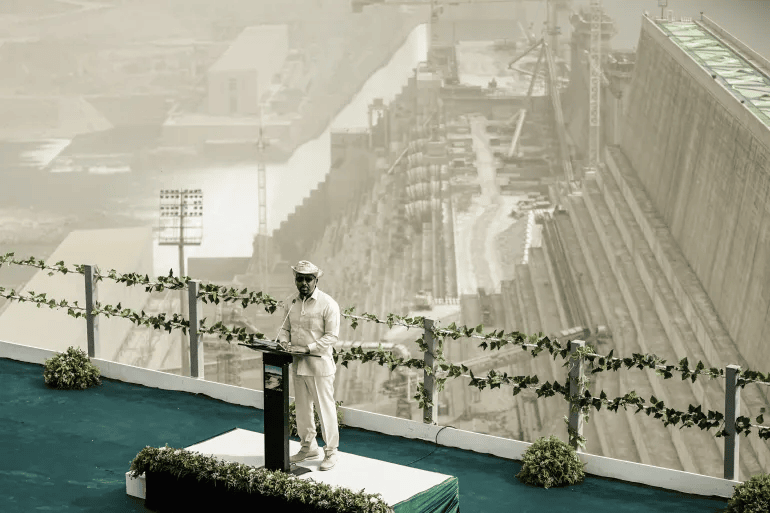
Ethiopia’s Prime Minister Abiy Ahmed speaks during the first power generation ceremony at the site of the Grand Ethiopian Renaissance Dam (GERD) in Guba, Ethiopia. Source: Al Jazeera.
What seemed for many Ethiopians a distant mirage, a mere hope, had finally become a reality with the dam’s completion and made many more imagine a future where the demand for basic electricity is finally answered. However, amongst this overwhelming excitement, I would like to draw my reader’s attention to consider his or her unmet need, not in isolation, but within the broader field of other economic demands.
Our lives are filled with constant struggle to address our immediate and long term demands, and it is the duty of the government to step in and supply the resources fairly so that each individual will have the opportunity to work towards alleviating such needs. Mega-projects such as the GERD are precisely the initiatives taken up by the government in the hopes of eliminating the predicaments standing in between the people’s demands and the means to realise them. However, if such projects were led to serve other motives than their professed aim, it is all the more necessary to be cautious on the part of the public towards such projects. Therefore, given that I provide adequate evidence to that effect, I want my readers to remain cautiously oriented as well towards GERD).
In the subsequent sections, I will attempt to demonstrate why such suspicion is warranted and is born out of the resentment due to the worsening of living conditions of ordinary citizens, which the projects did little if nothing to prevent. I will also emphasize the reason behind the failure to organize behind a unified front against the political establishment’s hegemonic dominance and the need to rearticulate the political field. The government’s appeal to nationalist sentiments only serve to distract and neutralize the public from confronting their actual economic condition and it is only by articulating anew a political field that opens up a space for a radically new form of democracy that could potentially address the peculiar predicament in which we find ourselves today.
The analytical framework of this study is grounded in the political theory of radical populism developed by Ernesto Laclau and Chantal Mouffe. The aim is not merely to describe the current political situation, but also to consider how diverse social and political demands might be articulated together in a way that forges a shared collective identity. By examining how various grievances and aspirations can be linked across different groups, the study seeks to show how a unified political front could emerge in opposition to the existing establishment, one capable of producing durable and transformative change.
Ernesto Laclau and Chantal Mouffe are Argentinean political thinkers best known for reimagining how collective identities are formed in modern politics. Their work shows that groups don’t simply come together because they share the same background or interests, but because they learn to frame their different struggles as part of the same larger fight. This perspective is useful here because it helps explain how scattered grievances across society might be linked to form a broader, unified movement. In other words, their theory offers a way to think about how people who feel unheard or sidelined can turn that feeling into a shared political voice strong enough to challenge those in power.
The GERD Under Context
The GERD has undoubtedly the potential to transform the economic condition of the country. It is the largest dam in the continent and is projected to generate 5,150 megawatts (MW) and a capacity to contribute 1 billion US dollars in revenue to the economy. This is a huge success for the country considering the funding that was collected for the construction of the dam was sourced from local and diaspora donations, and also government bond programs, in the absence of any foreign aid.
Moreover, there is a direct relation between economic development and energy. Without having a sustainable and adequate energy source, there won’t be hospitals to undertake basic medical procedures, industries to manufacture materials and equipment, businesses to run properly and healthy life to cook, heat and use light to go about daily activities. The lack of access to electricity has severe consequences of denying people the opportunity to improve their lives and lift themselves up from poverty.
To realize the fundamental economic rights of every citizen recognized in the constitution, it is indispensable to ensure the total inclusion of electricity coverage to every corner of the country. Despite the necessity of its demand, the 80% of the country’s population who dwell in rural parts still utilize firewood, charcoal, animal dung and gas in place of electricity for lighting. As a result, it becomes impossible to operate modern medical equipment in hospitals and deliver quality education to students, not to mention the difficulty it creates to even undertake day to day activities.
With the construction of the GERD and its installed capacity of 5150 MW, the current national energy production, which approximately amounts to 5200 MW as per the reports published by the international Trade Administration, will double with enough potential to power the whole country and even beyond to generate a surplus for export to neighboring countries, including Sudan, Kenya, Djibouti and Tanzania.
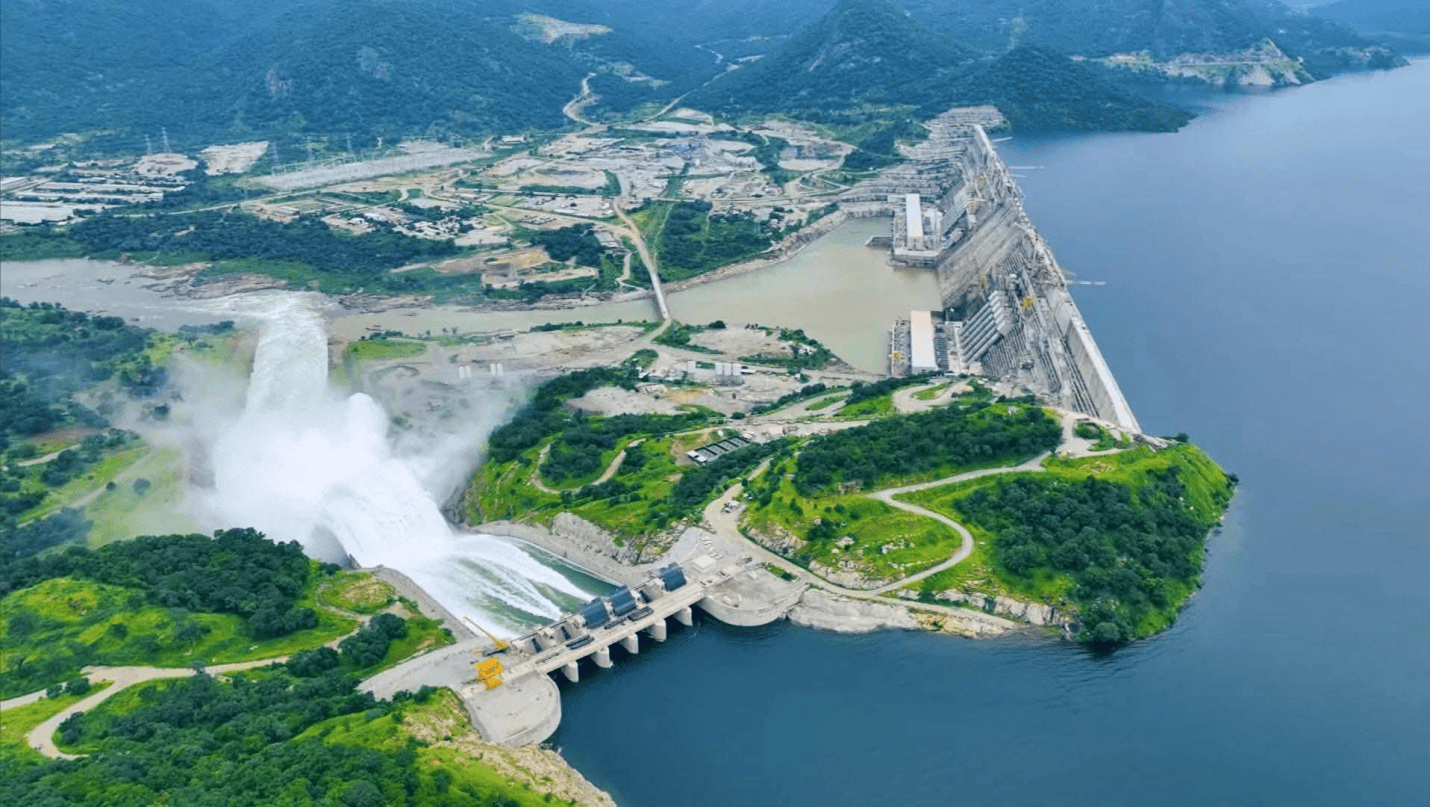
A drones image of the GERD showing the entire construction site along with the reserved water. Source: Ethiopian News Agency.
However, such a megaproject has not passed unnoticed. On the contrary, it stirred a major geopolitical controversy between the source country Ethiopia on the one hand, and the downstream countries Sudan and Egypt on the other, through the dam’s entire stage of construction and beyond. The latter have consistently protested either against the construction or the usage of the dam stressing that the water flow necessary for the sustenance of their country will be severely affected.
Further, they contend that there are international agreements such as the water-sharing agreement concluded between Britain and Egypt in 1929 and its derivative agreement sealed in 1959 between Egypt and Sudan that allow the exclusive usage of the Nile waters requiring the two nation’s consent for the construction of the dam. Ethiopia in return vehemently opposed such claims asserting its sovereign right to use the waters to realize its development agenda by refusing to be bound by any agreement concluded in the colonial era and in which it hasn’t participated. But, acknowledging these issues as worthy of deliberation, I would like to address the issue from another perspective and forward my immanent critique.
Here, I contend that it is crucial to pose the question that concerns the absolute majority of the country’s population. In the period subsequent to the fall of the monarchical system, the organizing political theme has oscillated between the category of the class and the category of the ethnic. With the coming of Ethiopian People’s Revolutionary Democratic Front (EPRDF) to power, after overthrowing the Derg regime, the political field has been articulated along ethnic lines to produce identities with which ultimate sovereignty lies, as if those identities were the organic, natural particulars whose antagonistic relation to the ruling regimes was concealed by monarchical and communist ideological control. But, now that these ethnic identities have been emancipated and returned to their original and rightful place, antagonism seems “finally” reconciled.
On the other hand, we see a surge in right wing nationalist populism in the political establishment of today’s leadership to appeal not so much for a lost state which Ethiopia needs to return to, but rather to a “prosperous” state which Ethiopia meant to reach if not for the “Other’s” impediment, be it Eritrea, Egypt, Somalia or western super power’s hegemonic control. The political establishment asserted time and again that the projects it has commenced and “delivered” will have the potential to create a self-sufficient and sovereign Ethiopia. But, I argue that such claims should be approached with great care given that the political establishment’s megaprojects indicates the contrary in changing the economic condition of the poor and working class Ethiopians.
The country is characterized by a huge income inequality among its citizens, an astounding level of poverty partly due to maladministration and partly because of war and a high level of unemployment. The mega projects so far initiated had little to do with addressing this predicament, if not worsening the situation.
Why The Need For Suspicion?
Since 2018, the Prosperity Party government under Prime Minister Abiy Ahmed has embarked on a sweeping agenda of infrastructure-driven modernization. The discourse surrounding this new developmental drive was framed by the promise of “prosperity” using mega-projects as the material proof of state capacity and progress. The government projected that large-scale projects in energy, industry, transport, housing and urban redevelopment would propel Ethiopia into middle-income status, generate millions of jobs and extend the benefits of growth to ordinary citizens..
The Prosperity Party inherited ongoing infrastructure programs from the EPRDF as well as introducing its own. Among these, the industrial parks, urban housing schemes, the Chaka Project, the Addis Ababa City Corridor initiative, the Gorgora tourism project and energy and industrial investments such as the Koysha Dam and Dangote fertilizer plant stand out as the major undertakings that have materialized during the current administration.
The industrial park program represents one of the most visible components of Ethiopia’s industrialization vision. Initiated during the EPRDF years, it was aggressively expanded under the Prosperity Party through the construction and operationalization of parks such as Bole Lemi II, Kilinto, Kombolcha and Adama. These parks were promoted as job creation opportunities intended to absorb Ethiopia’s growing youth population into stable and export-oriented employment.
Yet, while they did produce tens of thousands of jobs on paper, the quality and sustainability of those jobs remain highly questionable. Reports have revealed extremely low wages, long working hours, poor conditions and mass job loss of workers unable to meet basic living costs. For most workers, nominal employment has not translated into improved livelihoods, as inflation in food, housing and transport has far outpaced wage growth. Ever since the suspension from the African Growth and Opportunity Act (AGOA) in January 2022 by the Biden administration, the country sustained a huge loss of 18 foreign companies leaving the country, over 11,500 jobs lost and industrial parks suffering a combined revenue loss of USD 45 million.
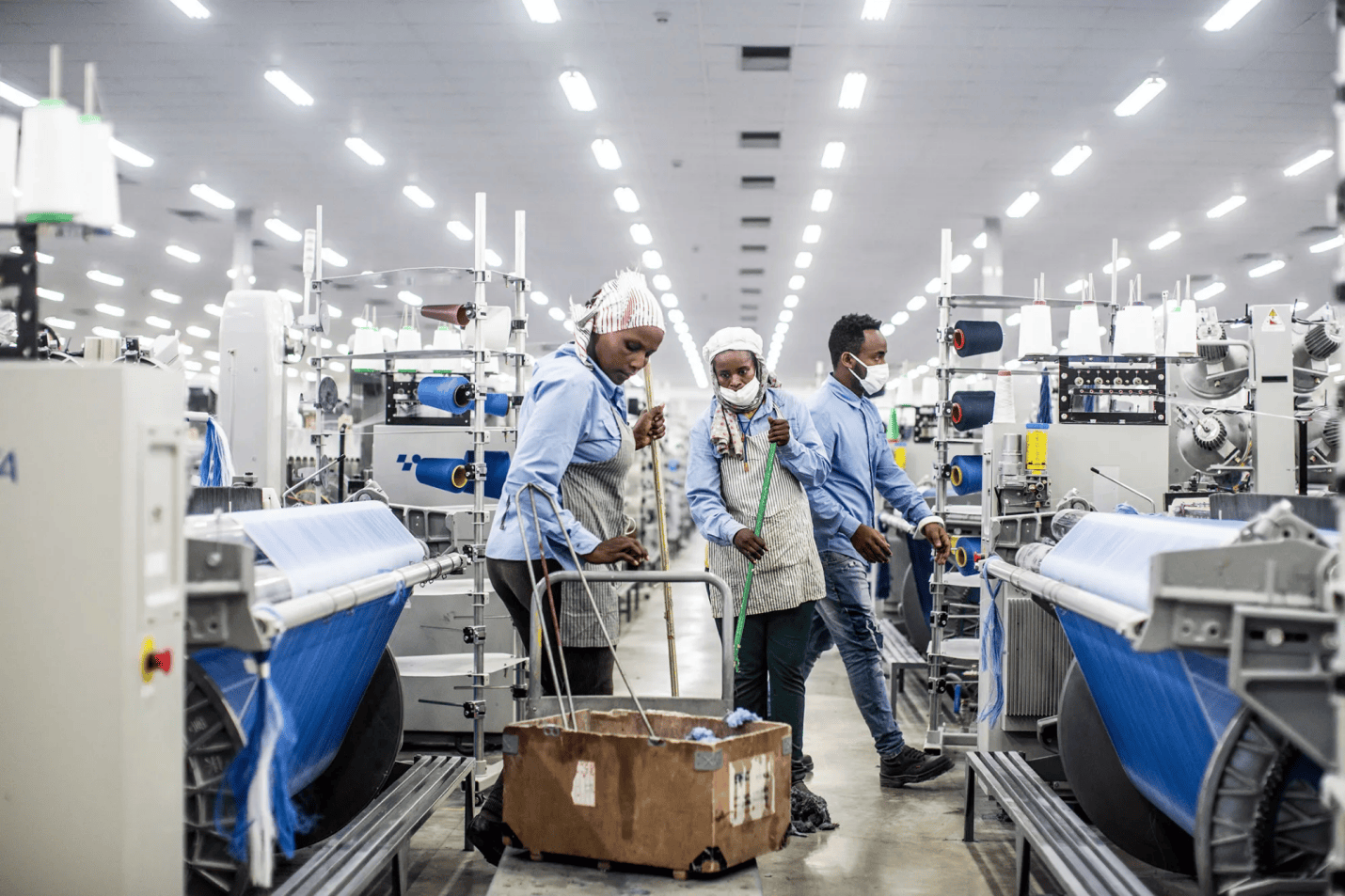
Textile workers cleaning the floor in the industrial park located in Hawassa. Source: Nichole Sobechi for Bloomberg.
The Chaka Project in Addis Ababa epitomizes the Prosperity Party’s desire for prestigious urban transformation. Branded as a “smart city” and “forest resort” project, Chaka encompasses luxury residences, artificial lakes, forests and a new presidential palace. With a budget reportedly exceeding 500 billion birr, it has come to symbolize a conspicuous form of state-sponsored consumption rather than a response to urban deprivation.
The project’s implementation has involved the displacement and eviction of local communities and the reallocation of prime urban land to state-linked developers, raising profound questions about whose “modernity” it meant to represent. For many residents of Addis Ababa, such projects exemplify a form of developmentalism that beautifies the city for elites and tourists while rendering it less livable for the working poor who face eviction and rising living costs.
A similar critique applies to the Addis Ababa City Corridor Project, which was designed to modernize the capital through road expansion, pedestrian walkways, and aesthetic urban corridors. Though justified in the name of reducing congestion and improving urban efficiency, the project has entailed extensive demolition of informal housing and displacement of small traders. The resultant economic dislocation of low-income families and street vendors has exacerbated urban unemployment and widened inequality. For affected residents, the “beautification” of the city has meant exclusion and loss of livelihood.
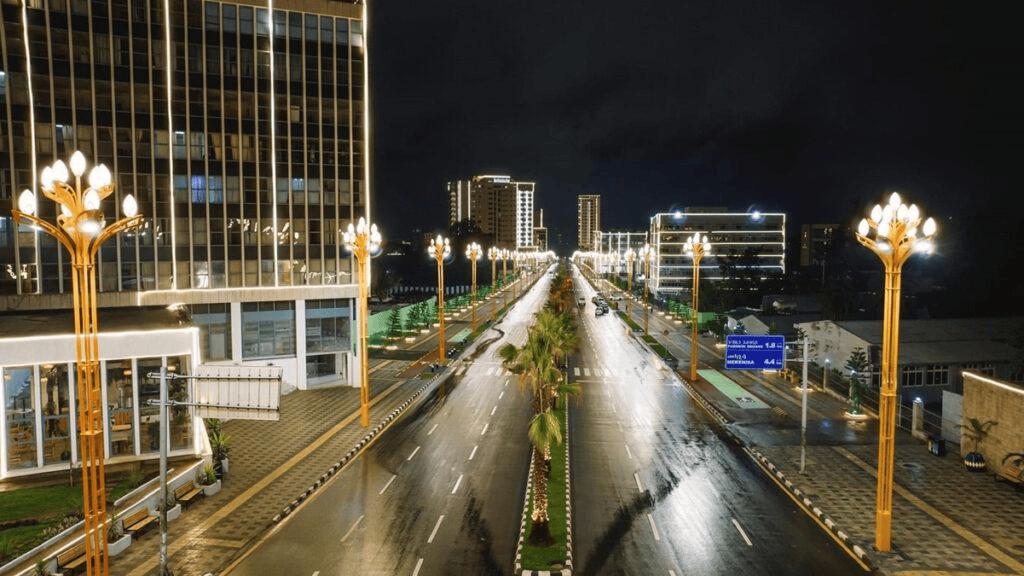
The recently completed Mexico-Sarbet corridor, developed under the city’s Corridor Development Project. Source: Addis Standard
This demonstrates that these undertakings have failed to achieve key social and economic objectives. While their apparent manifestations may appear to represent national ambition, in terms of bringing about economic and distributive outcomes, they have resulted in undesirable consequences. Instead of bringing tangible relief to the urban poor and rural working population, many of these projects have aggravated inequality, contributed to inflationary pressures and concentrated wealth and opportunity in the hands of a few politically connected elites. They have thus functioned less as vehicles of collective transformation and more as mechanisms of elite accumulation and political spectacle.
If the projects under implementation illustrate the limits of Ethiopia’s existing development strategy, the new wave of announced mega-projects such as the proposed nuclear power plant, oil refinery, natural gas facilities, and the new Bishoftu mega-airport reveal an even more ambitious but equally questionable continuation of the same model. Announced in 2025 as part of a $30 billion infrastructure package, these projects were justified by the government as essential to national sovereignty, industrial self-sufficiency and technological modernization. These projects are made public at a moment when the country was already stretched thin due to prices climbing, stagnant salaries, foreign currency shortage and rising of debt.
Announcing billion-birr ventures in the middle of all this seems to exhibits a lack of prudent economic planning. The government frames them as pathways to prosperity, but when the money to build them isn’t really there, the cost is pushed quietly onto ordinary people through inflation and onerous taxation. That is why their timing and financing naturally raise suspicion. Instead of easing the pressure on daily life, they risk tightening it further, leaving citizens with empty promises of progress, while the lived reality grows heavier by the day.
What Is To Be Done? Radical Democracy
In the above analysis, I endeavored to highlight the various ongoing mega projects initiated by the political establishment and showed, in contrast to the latter’s continuous promises to address the actual predicament of the economic condition which poor and working class Ethiopian face day to day, how it failed to do so. Then one should ask, what is to be done? What should be done, when the political establishment ignores and shies away from the grievances and suffering of ordinary people? In order for this demand to translate into any meaningful political struggle, a rearticulation of the social and political field is required.
However, the political domain has already articulated subject positions along ethnic categories. The proper and radical populist democracy would begin by gathering the everyday struggles people are living through such as the struggle to find work, the school fees that can’t be paid, the clinic that is too far or too expensive and the price of food rising faster than wages. Instead of treating these hardships as isolated problems, such a politics would show how they are connected and how they originate from the same political and economic order. To do this, it would create a shared language across these different demands, using broad unifying words such as “justice” or “equality”. These terms serve as common reference points through which people recognize themselves as part of the same struggle. In populist theory, this means forming what is called a “chain of equivalence,” where different grievances are linked together to form a single collective voice.
The differences among the people involved, whether based on ethnicity, gender or class, do not simply disappear in this process. Instead, they are temporarily held in suspension in order to speak together in a unified way. What allows this unity to form is the use of an “empty signifier,” a word or symbol whose very openness makes it possible for different groups to invest their own hopes and meanings into it. In this way, the political “people” comes into being not because everyone is the same, but because they share a sense of being failed by the same establishment.
This is also where antagonism enters, because a unified political “people” is formed only when there is a clear sense of who they are struggling against. In our case, the government works hard to present itself as already united with the public by pointing toward outside threats or foreign enemies as the “other”. This narrative tries to conceal the internal divide. But once this image is peeled back, what becomes visible is the confrontation between the public grappling with daily hardship, and on the other, a political class that claims to act in their name while simultaneously producing the very conditions that keep them struggling..
It is important to understand that the unity of the people, meaning, the way different groups come together, does not exist naturally. It is not a pre-given condition waiting to be revealed. Instead, this unity emerges only in response to a shared struggle against a common concern. What binds these groups together is less a shared achievement than a shared frustration, a sense of what is missing in their lives ranging from poor access to schools and healthcare to unemployment and rising prices.
This lack, rather than a positive or fully realized demand, becomes the basis for a collective voice. In this context, words like “justice” or “equality” act as quilting points that allow people from diverse backgrounds, whether defined by ethnicity, gender, or class, to unite under a shared banner. By strategically linking their distinct grievances into a common narrative, these groups can transform particular struggles into a universal demand for change. They do not invent entirely new language but often repurpose terms already used in public discourse, turning the very words of the establishment into tools for resistance. In this way, what appears as a spontaneous collective identity is in fact a carefully constructed political front, born from dissatisfaction and articulated through shared symbols, rather than from any pre-existing unity among social groups.
The aim of populist politics is emancipation, but not in the sense of returning to some untouched, ideal state of nature from which people were allegedly alienated. Instead, it relies on what can be called an “illusion of emancipation”, which is a shared vision of freedom and justice strong enough to mobilize people against the political establishment. This vision is necessary because it challenges the dominant narratives that the government uses to present itself as the natural and self-evident.
As noted, signifiers such as “justice” or “equality” allow isolated and diverse grievances to be linked together. When people unite these demands under common terms, they can go beyond the individual struggles into a broader, collective political claim. This act of naming and framing these grievances provides the people a space to build up a political front even if the promised fullness of emancipation remains out of reach. In this sense, populist mobilization works by creating a shared image of liberation, which nonetheless acknowledges the actual realization of complete freedom to be only provisional..
Last Remark
In the final analysis, what I am working out towards is to insist that it is high time to adequately articulate the apparently neutral “economic” condition of the country in light of radical democratic populism. To do so, we need to submit to scrutiny the claims made by the government regarding the various mega projects that would transform the country, including the GERD. The political establishment is elevating GERD and also in some cases access to the Red Sea, to have a symbolic status and use it as a kernel over which the people’s nationalist identity is organized.
In an attempt to stabilize this symbolic order and neutralize the antagonism within, it has created the “Other”, in some cases Egypt and in others Eritrea, that impedes Ethiopia from realizing its full potential. We are seeing the ultimate manifestation of this false populism in the case of the strife with Eritrea, where the Prime Minister, including military officials, assert that Ethiopia will reclaim Assab port by any means necessary.
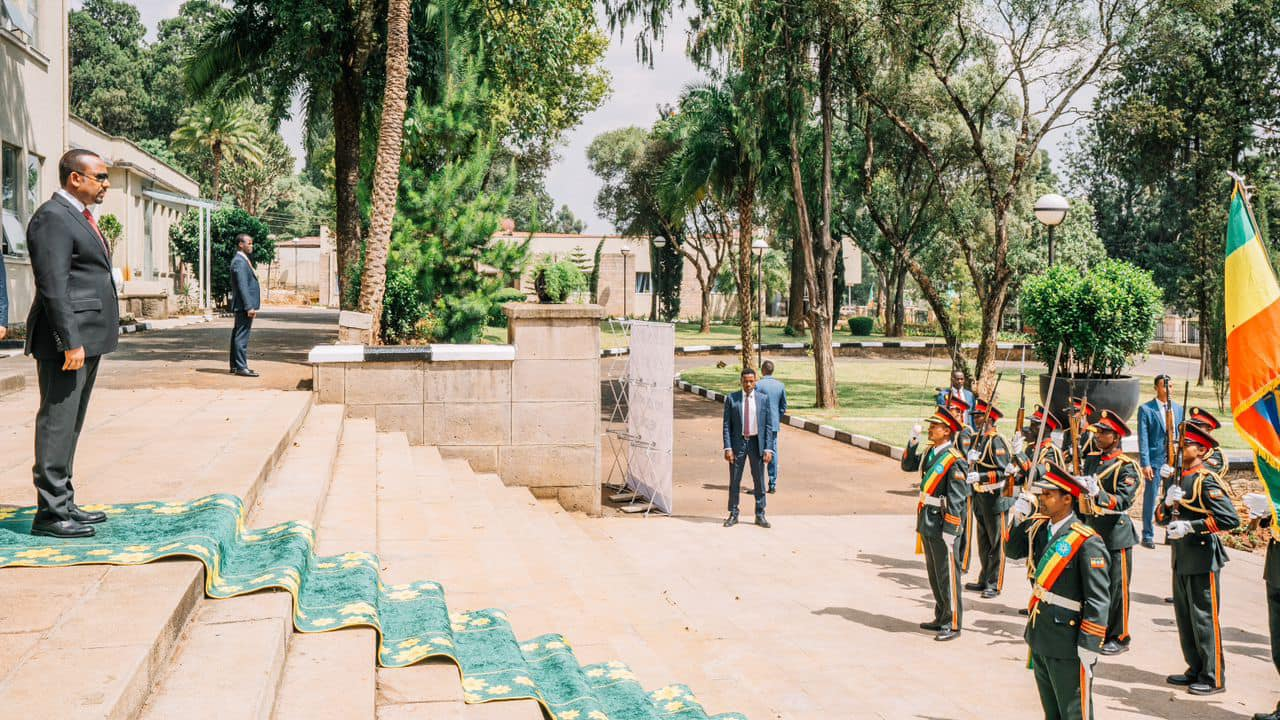
Ethiopia PM Abiy Ahmed Ali at the opening of parliament, 9 Oct 2023. A few days later in parliament, he made a speech announcing Ethiopia’s intention to secure a port and sea outlet on the Red Sea. Source: Office of the Prime Minister.
This shows how blind the political establishment is to the very negative ground on which it is founded, in its attempt to establish a natural, necessary and neutral “national” identity. It is ignorant to the fact that the attempt to overcome the other in pursuit of a political demand could result in ultimate defeat since the loss of the other brings about the destruction of the identity that emerges from the internal demands.
As we tried to elaborate in detail in the preceding sections, insofar as there is an internal antagonism that pervades the subject with incompleteness, the enemy or the “Other” is just an externalization of the subject’s own negativity. The political establishment masquerades to answer the various demands which we mentioned, despite the fact that they are the result of its administrative inefficiencies, as if they will go away if the antagonistic relation is directed towards the “Other” and its hegemonic control is finally broken to pieces. In doing so, the political establishment is hiding the very source from which the demands sprung in the first place.