The Sudanese economy represents a complex and multifaceted case of resource curse dynamics and "Dutch disease". Since the discovery of oil and the beginning of its exports in the late 1990s, particularly in 1999, the economy has undergone radical structural transformations that profoundly affected its development trajectory, financial stability, and productive structure.
The massive inflow of foreign exchange revenues triggered a temporary positive income shock, but it was accompanied by the systematic neglect of traditional productive sectors such as agriculture, livestock, and manufacturing.
This left the national economy vulnerable to fluctuations in global markets and geopolitical events until the outbreak of the April 2023 war.
First: The era of oil abundance and the manifestations of Dutch disease (1999–2011)
The Sudanese economy experienced an unprecedented surge in GDP growth rates following Sudan's entry into the club of oil-exporting countries in the late 1990s. The economy grew sixfold in terms of nominal GDP, rising from $10 billion in 1999 to $60 billion in 2010. During the same period, total export values increased, with oil revenues accounting for more than 90% of total export earnings.
However, this boom generated deep structural imbalances. First, it led to an appreciation of the real exchange rate, as the massive influx of foreign currency artificially strengthened the local currency and undermined the international competitiveness of non-oil sectors such as cotton and gum Arabic.
This was accompanied by the severe marginalization of the agricultural and industrial sectors. Although agriculture remained the backbone of the economy and the primary livelihood of the vast majority of the population, cultivated areas remained limited, and the country became heavily dependent on food imports. Meanwhile, manufacturing experienced significant contraction relative to the massive growth of the oil sector.
The concentration of investment in services and real estate further expanded the non-tradable sector, creating imbalanced growth. The country recorded an average negative net savings rate of 7.4% between 2000 and 2010, reflecting the depletion of wealth and the absence of sustainable capital investment.
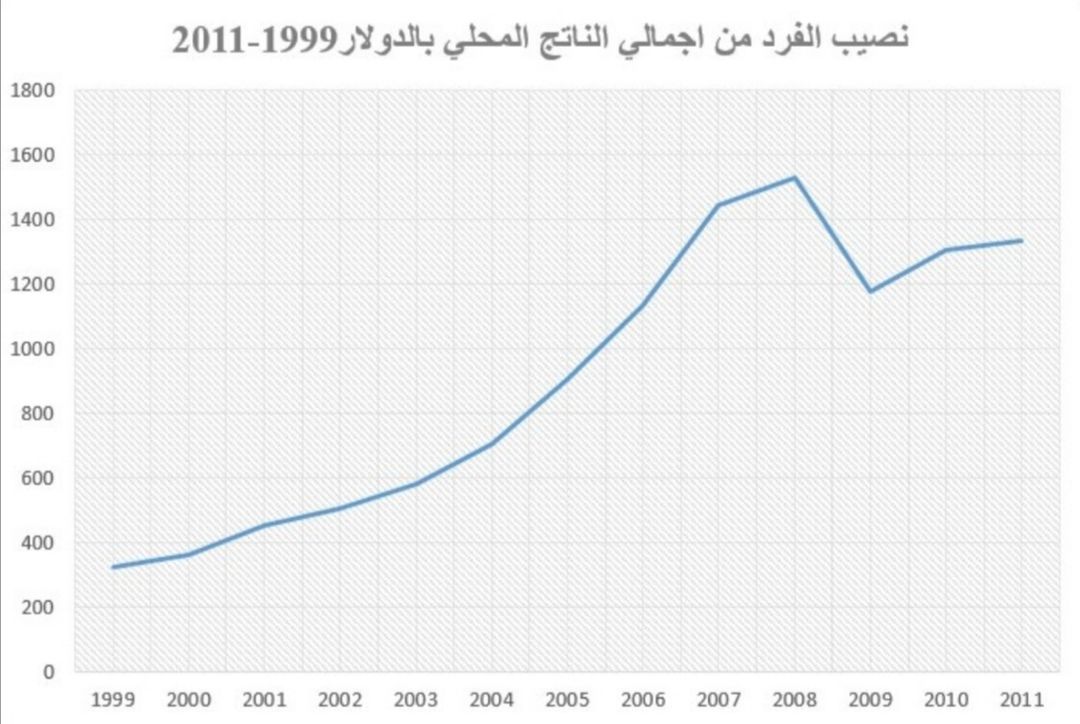
GDP per capital in US dollars (1999–2011). Data source: Trading Economics. Data visualization: Bara’a Mohamed.
Second: The secession shock and the erosion of the economic base (2011–Pre-War)
The year 2011 marked a catastrophic turning point in the history of Sudan's modern economy following the secession of South Sudan. This resulted in Khartoum losing approximately 75% of its proven oil reserves, nearly half of its government revenues, and more than 80% of its foreign exchange earnings. Estimates by the International Monetary Fund (IMF) and World Bank missions indicate that the secession inflicted direct economic losses of approximately $11.4 billion, equivalent to roughly 26.3% of Sudan's GDP in 2012.
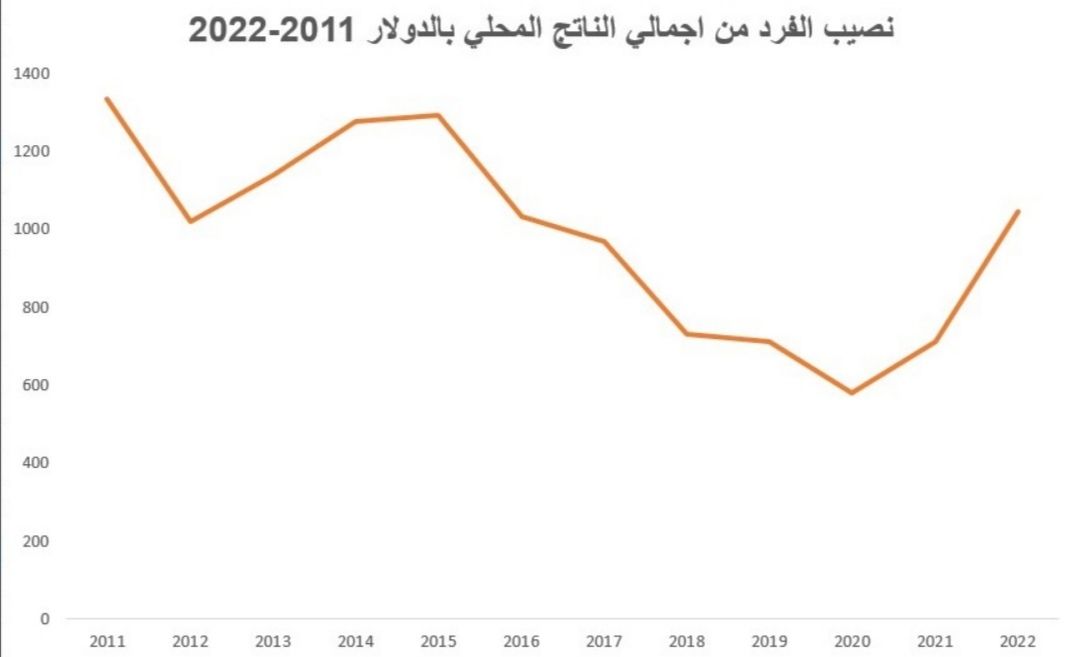
GDP per capital in US dollars (2011–2022). Data source: Trading Economics. Data visualization: Bara’a Mohamed.
This dual shock triggered a series of cascading structural crises, including a severe trade and fiscal deficit that widened the budget gap. This pushed the state toward deficit financing through money printing to meet its basic obligations, unleashing waves of runaway inflation. These repercussions intensified with the sharp depreciation of the national currency due to foreign currency shortages and the emergence of multiple parallel exchange rate markets.
Sudan's external debt also worsened, exceeding $60 billion, effectively cutting the country off from international financial markets and lending institutions. These constraints continued to undermine any attempts at comprehensive reform, amid the absence of genuine strategies to diversify sources of income.
Third: The State of the Sudanese Economy from Late 2022 to the End of 2025
The war that erupted in mid-April 2023 marked a historic turning point, triggering a profound and devastating structural shock to the Sudanese economy. While the economy was already suffering from conventional imbalances and a substantial trade deficit prior to the outbreak of conflict, as reflected in the fourth-quarter 2022 indicators, largely due to the volume of imports far exceeding exports, the war intensified these crises and plunged the country into an unprecedented cycle of contraction and deterioration.
The effects of this shock are clearly evident in the collapse of real growth rates, the decline in foreign trade volumes and the structure of exports and imports, as well as successive waves of runaway inflation and the collapse of the national currency's purchasing power throughout 2024 and 2025.
In this context, according to reports and indicators published by Visual Capitalist, Sudan was ranked among the world's worst-performing economies in 2025 amid the continuing repercussions of the devastating conflict.
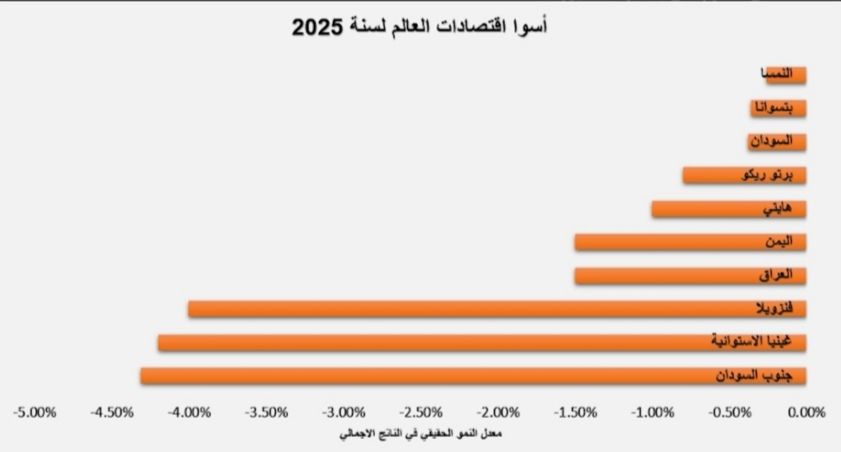
Sudan ranked as the world's eighth worst-performing economy in 2025. Data source: Visual Capitalist. Data visualization: Bara’a Mohamed.
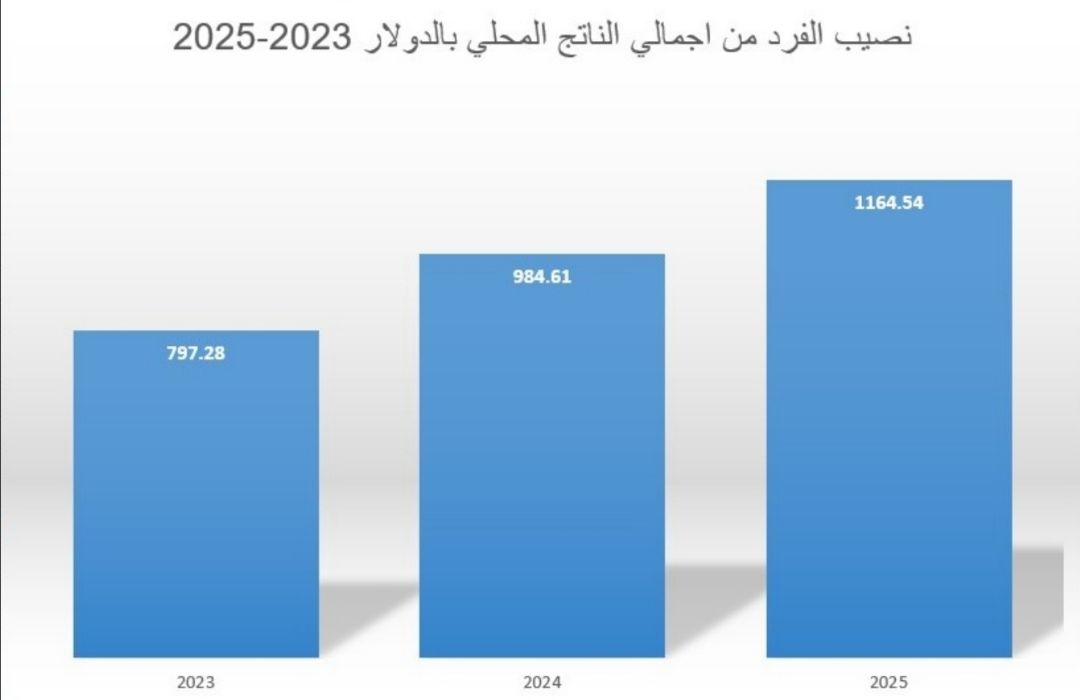
GDP per capita in US dollars (2023–2025). Data source: Trading Economics. Data visualization: Bara’a Mohamed.
In terms of economic growth and gross domestic product (GDP), the economy witnessed a sharp collapse in output. The war that broke out in mid-April 2023 brought infrastructure and productive activities to an almost complete standstill, resulting in extraordinarily negative real growth rates. GDP growth plunged to a catastrophic −29.2% in 2023, followed by a slight improvement to −12.7% in 2024, according to preliminary estimates by the Central Bank of Sudan.
These figures reflect an unprecedented contraction in the size of the national economy. This was accompanied by a halt in investment and the disruption of the capital account, with major capital transactions in the balance of payments disappearing entirely in 2023 and 2024 as domestic and foreign investment flows came to a standstill and capital assets were destroyed.
Regarding exports, imports, and changes in the structure of foreign trade, trade volumes contracted, and the country shifted from a massive trade deficit to a smaller one. In the fourth quarter of 2022, the pre-war period, total annual exports stood at approximately $4,357.4 million, compared with imports of $11,094.8 million, resulting in a substantial trade deficit of $6,737.4 million. In 2024, total exports declined to $3,134.5 million, led by gold at $1,570.2 million and livestock at $530.5 million. Imports contracted sharply, falling to $4,911.2 million, narrowing the trade deficit to approximately $1,776.7 million as a result of foreign currency shortages and the country's reduced import capacity.
This contraction also resulted in the collapse of strategic export sectors. Productive sectors were severely damaged, with slaughtered meat exports, for example, suffering a dramatic collapse to negligible levels compared with more than $81 million before the war. Exports of certain cash crops, including watermelon seeds and sesame, also declined due to disruptions in supply chains and production areas.
With regard to inflation and exchange rates, the economy experienced severe, volatile, and exceptionally high inflationary waves. Headline inflation reached 215.5% by the end of September 2024, before easing somewhat to 187.8% by the end of December 2024. These levels were driven by the continued erosion of the local currency's purchasing power and shortages of essential goods. In parallel, the Sudanese pound depreciated sharply, with the weighted average US dollar exchange rate across commercial banks and exchange bureaus rising from approximately SDG 998.11 at the end of December 2023 to SDG 2,073.21 by the end of December 2024, further increasing import costs and fueling price inflation.
The impact of the war also extended to major economic sectors. Agriculture and pastoral activities were affected as vast areas in conflict zones were removed from the agricultural cycle, while markets, seed stocks, and pesticide supplies were destroyed. Imports of pesticides, tractors, and seeds declined significantly compared with 2022, alongside the displacement of farmers and pastoralists, threatening national food security.
In the mining sector, despite gold remaining the largest contributor to export earnings, generating more than $1.5 billion in 2024, production and exports faced structural disruptions, obstacles, and partial evasion of formal regulatory channels. Monthly gold export volumes fluctuated considerably throughout 2024 and 2025.
Meanwhile, the financial and banking sector suffered looting and partial destruction of banking networks and branches in conflict areas, disrupting electronic payment systems and undermining confidence in the monetary system. These developments were compounded by a public budget deficit and a decline in actual revenues relative to emergency expenditure needs.
The Economic Outlook for 2026: An Analytical Perspective from Inside the Central Bank of Sudan
In an interview with an economic policy expert at the Central Bank of Sudan conducted for this article, the expert noted that Sudan enters 2026 burdened by deep scars left by successive years of war. The crisis has reached a critical stage, clearly reflected in indicators of monetary and livelihood distress. Headline inflation illustrates this disparity between early 2025 and early 2026.
While inflation fluctuated sharply, exceeding 118% at certain points during the previous year before declining to approximately 68.2% by December 2025, annual inflation stood at 60.26% in January 2026. Subsequent periodic reports by the Central Bank of Sudan indicated a further statistical decline by mid-year, reaching approximately 26.1% by the end of August 2026. Official reports attribute this decline to severe liquidity shortages and contraction in aggregate demand rather than any recovery in productive activity.
Regarding the US dollar exchange rate, the expert explained that it had surged dramatically, reflecting the erosion of the national currency. In January 2025, the dollar traded at approximately SDG 1,980–2,650 across official banks and the parallel market. The situation deteriorated dramatically in 2026, with the exchange rate exceeding SDG 3,500 and climbing to more than SDG 9,000 in parallel market transactions in October of that year. This was accompanied by an astronomical expansion of the money supply, which approached 20.5 trillion Sudanese pounds by the end of September 2026. This has wiped out household savings and brought banking financing networks to a near standstill, leaving livelihoods hostage to a parallel market governed by the law of survival rather than the state.
Analyzing the underlying causes of this situation from within the corridors of monetary policymaking institutions, the expert added that 2026 represents the peak of a dual structural shock. Sovereign revenue channels have been disrupted, and traditional exports have largely come to a halt, with gold remaining an exception through unstable channels. This has resulted in a severe and persistent structural deficit in the balance of payments.
The economy's descent into this critical state since the outbreak of war can be traced to several fundamental factors, primarily the forced resort to deficit financing and monetary issuance to cover emergency expenditure, in the absence of genuine productive backing. This has been the principal driver of historic inflation in the monetary base.
Other factors include the removal of major intermediary regions from the agricultural and industrial production cycle, the disruption of domestic and international supply chains that once sustained the real economy, and the rapid abandonment of the Sudanese pound by individuals and communities as a store of value. Faced with uncertainty and continued military shocks, people have increasingly turned to the US dollar, causing the parallel economy to absorb much of the cash circulation outside the formal financial system.
Financing Gaps and the Shrinking Revenue Base at the Ministry of Finance
In an interview with an employee at Sudan’s Ministry of Finance and Economic Planning conducted for this article, he spoke candidly about the scale of the crisis the ministry manages daily, describing work under a war economy as “walking barefoot on glass.” He noted that the biggest challenge facing the ministry at the beginning of 2026 was the near-total evaporation of traditional revenue streams. Tax and customs revenues had collapsed after major production areas and commercial hubs fell outside state control, in addition to the shutdown of most factories and large companies that had previously contributed to public revenues.
The official elaborated on the daily dilemma: the ministry found itself facing moral and legal obligations to pay salaries and cover essential sovereign expenditures while the treasury was virtually empty. Resorting to the easy solution of printing money would have meant triggering hyperinflation and burning through what little remained in citizens’ pockets. Regarding the measures taken during the year, he explained that the ministry had resorted to adopting an emergency austerity budget based on expanding the limited remaining scope of electronic revenue collection, reprioritizing spending exclusively toward maintaining the minimum functioning of state institutions and supporting essential services, while attempting to curb leakages in the remaining revenues. He emphasized that 2026 had been a genuine battle for survival to prevent the complete collapse of the government’s financial apparatus.
Behavioral Economics and Spontaneous Dollarization: Why Is Everyone Buying Dollars
Why are ordinary people buying dollars? This was a question I posed to 83 respondents on Facebook. Of them, 71 believed the primary reason was a complete loss of confidence in the national currency and a desire to preserve the value of their savings by converting them into dollars. The remaining respondents believed people were buying dollars to resell them at a relatively higher price later.
The economic reality, however, is that what some perceive as profit from the price difference is not a real gain, but merely the ongoing erosion of purchasing power. People are not actually making money. At best, they are barely preserving their already eroding purchasing power, while the Sudanese pound continues to lose more of its value.
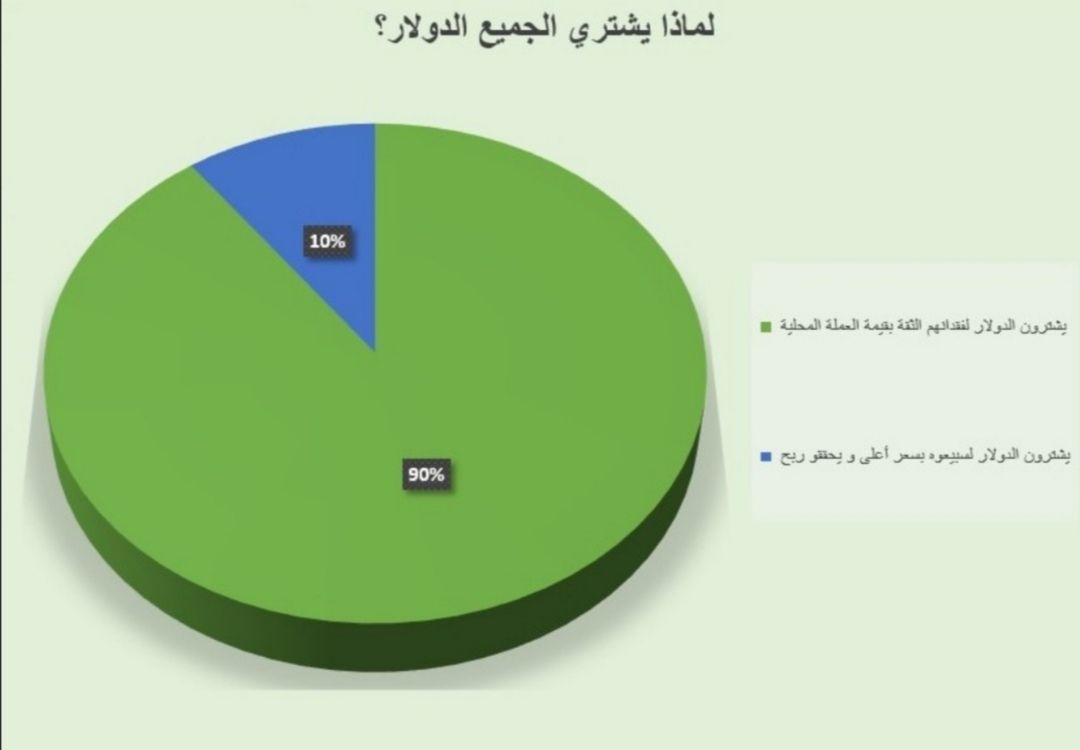
Why people buy dollars (response percentages). Data source: Bara’a Mohamed.
On the other hand, I met with Hisham Ahmed, a currency trader, who described a significant increase in the number of ordinary citizens seeking to buy foreign currency. He also spoke about mounting pressure from the government, which had intensified security and regulatory measures against informal currency trading. Despite this, Hisham explained that demand had not declined; rather, it had intensified, as purchases had become driven purely by consumption needs and precautionary motives, with households seeking to protect their daily livelihoods rather than engage in speculation.
Economic Recovery Prospects and Policy Visions for Salvaging Sudan’s Remaining Economic Structure in 2026?
The Central Bank of Sudan's economic policy expert explains that the recovery roadmap is built around precise monetary engineering aimed at reforming and restructuring the banking sector, curbing the expansion of uncovered monetary issuance through the withdrawal of deteriorated banknotes, and requiring liquidity circulating outside the formal system to return to the banking cycle. Credit would be directed exclusively toward real supply-side sectors, particularly agricultural and industrial production in secure states, to break the cycles of hyperinflation and stabilize the exchange rate.
From a fiscal perspective and within the broader structural outlook, the Ministry of Finance and Economic Planning employee explains that managing a war economy requires exceptional approaches to overcoming the budget deficit and the shrinking revenue base.
This was reflected in the Recovery Conference in Khartoum, held in partnership with the United Nations Development Programme (UNDP) and the Employers' Federation. This vision rests on practical mechanisms for risk-sharing, expanding financing channels, activating the Public-Private Partnership (PPP) law, and creating a flexible legislative and banking environment that provides grace periods for producers and supports value chains. It also emphasizes that genuine recovery cannot be separated from building social safety nets and revitalizing productive sectors capable of generating foreign exchange and rebuilding the national economy.
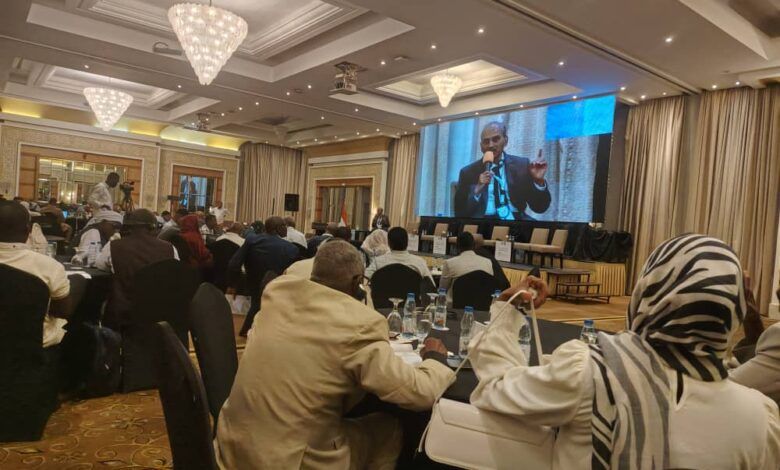
Khartoum Economic Recovery Conference. Source: Al Hadath News Channel.
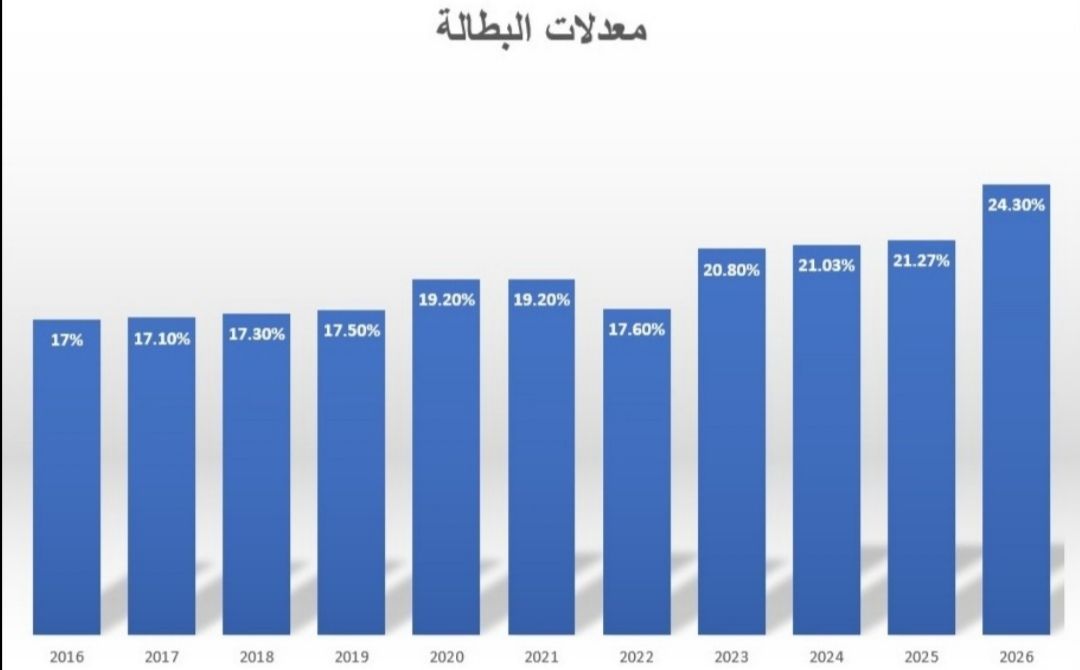
Sudan's unemployment rates over ten years (2016–2026). Data source: Trading Economics. Data visualization: Bara’a Mohamed.
Conclusion
The economic landscape of 2026 cannot be reduced to dry figures on central bank screens or austerity budget reports. The true face of this crisis is reflected in long queues, and in the cries of millions of frustrated citizens facing the relentless cost-of-living crisis and the erosion of what remains of their savings.
Today, with the dollar reaching the threshold of SDG 10,000 and long queues for fuel and bread stretching through city streets, the state as a whole is entering an extremely severe economic crisis, with no way of predicting where the situation may lead in the near future. When bread, daily necessities, and fuel become existential struggles, security crackdowns and parallel-market remedies are no longer capable of stopping the bleeding.
When asked about the current state of the economy and whether a breakthrough was imminent, the economic expert replied that the economy is now clearly governed entirely by the law of absolute survival. The Sudanese pound has lost its function as a store of value, while people on fixed incomes have seen their purchasing power disappear amid a devastating shortage of official liquidity and the complete paralysis of traditional banking payment systems.
As for the pressing question of when relief might come and when citizens' burdens might ease, based on my careful analysis of the Sudanese situation, I must be candid with the public: uncertainty is absolute, and there are no realistic or near-term indicators of a miraculous recovery. All current plans and temporary relief measures are little more than palliatives designed to delay total collapse without addressing the underlying structural disease.
To overcome this historic turning point and achieve even a glimmer of genuine recovery, the official vision requires a set of strict, indispensable strategic conditions:
- A comprehensive political and military settlement that ends the conflict and restores security and stability across states and productive regions.
- Restoring institutional and monetary control by reasserting the authority of the Ministry of Finance and the Central Bank of Sudan over resource hubs, and developing mechanisms to reintegrate the massive volume of currency circulating outside the banking system.
- Reopening international support and coordination channels with global financial institutions, including the IMF and World Bank, to secure debt relief and emergency financing packages.
- Returning to real production by revitalizing major export sectors such as gold, agriculture, and livestock to replenish foreign exchange reserves.
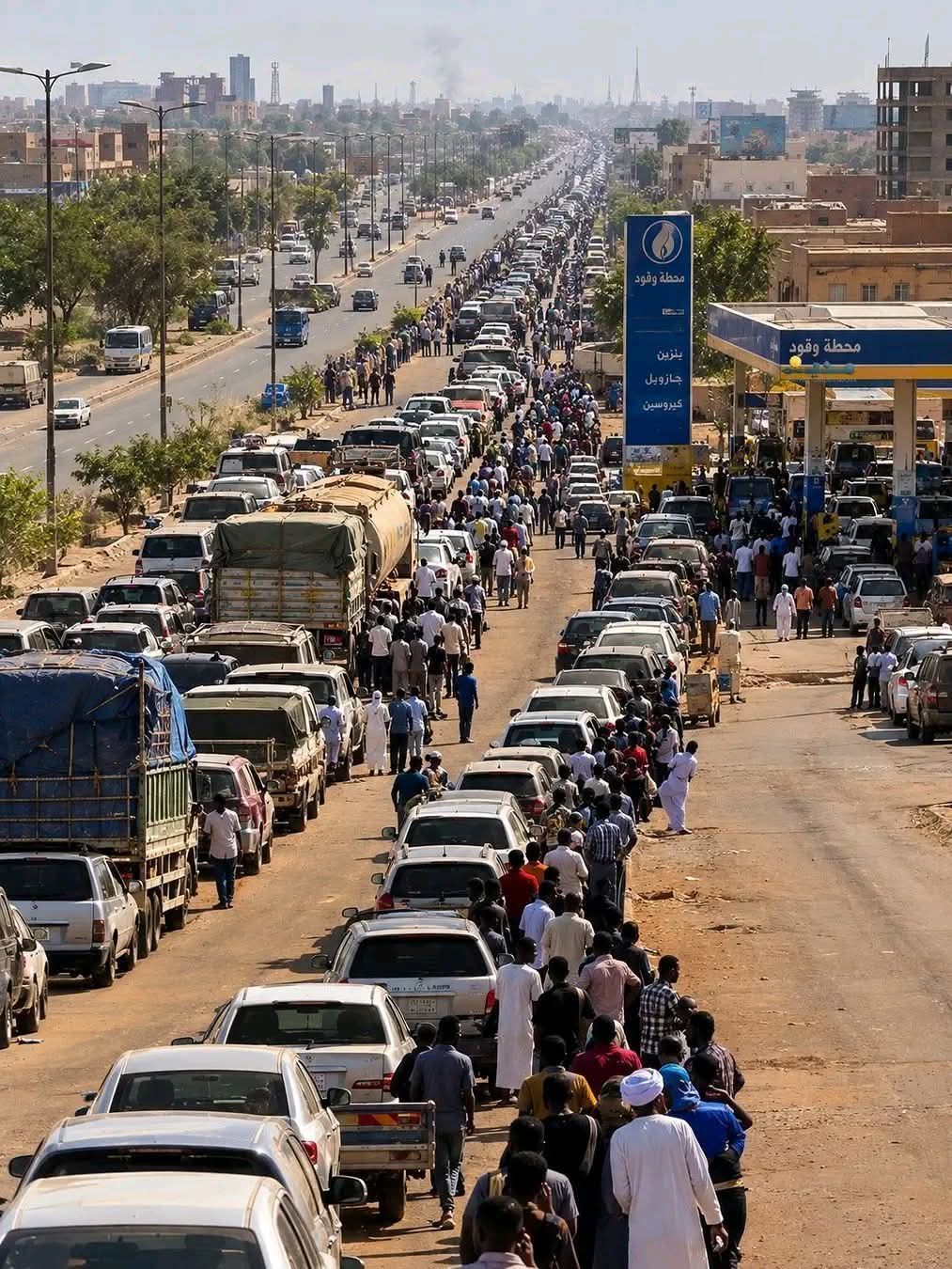
Long queues of vehicles at fuel stations in the capital, Khartoum. Source: Ayman Ismail.
The war economy is not merely a temporary financial crisis. It is a structural dismantling that threatens the economic, social, and livelihood foundations of Sudanese society as a whole. Unless a unified national will and a realistic recovery vision emerge to restore dignity to people and revive genuine production, Sudan will remain trapped in an endless cycle of collapse, where nothing speaks louder than the law of survival.