This article was written in collaboration with Dr. Khansa Taha.
In Jabal Nyuka residential area, located alongside Bahr Al Jabal river, in Juba, the capital city of South Sudan, the world’s youngest country. Flore Jada, a 53-year-old South Sudanese farmer at the river back, shared with us her daily struggle. “After every rain-storm, plastic waste comes from afar to cover the surface of the river and the river swells the plastic so it ends up piled at the edge of my yard,” Jada expressed.
However, she is not the only one who has observed this phenomenon. This scene contains enough fear to imagine the future of the river and at the same time raises questions about where these plastics come from and how this flow can be contained before the river turns into a plastic river?
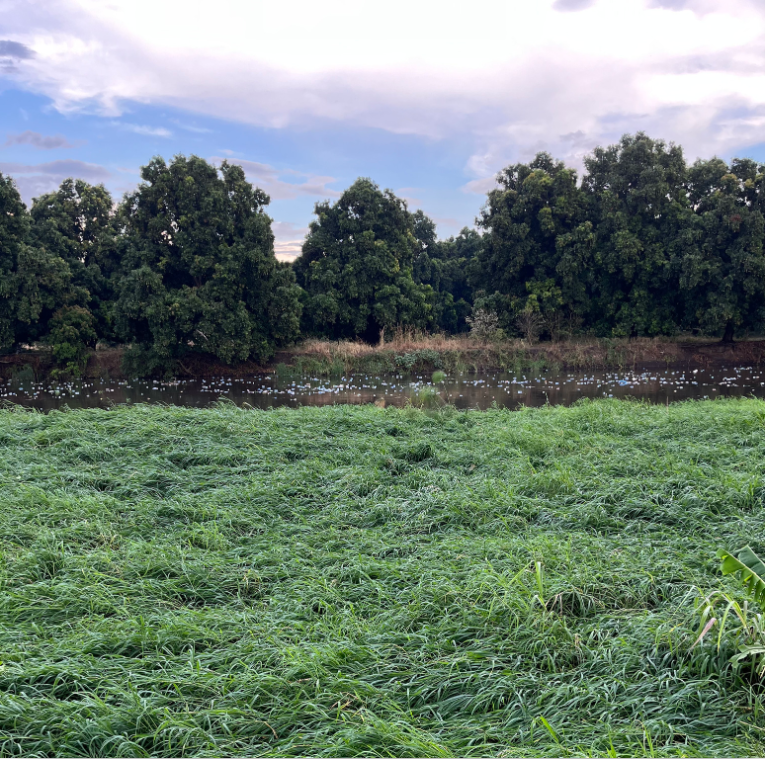
Bahr Al Jabal River, laden with plastic bags. Photo courtesy of Adam Ibrahim and Butros Nicola Bazia. Juba, South Sudan
As we continue talking to her, Jada shared more about the farming difficulties caused by the plastic waste. “I am watering my field directly from the river using special watering containers, and the pipe of the watering gets clogged by plastic, which leads to a longer time to finish the process as I have to stop and remove the plastic from inside" she said.
However, since the independence in 2011, Juba has undergone a rapid population growth, where informal settlements and inadequate infrastructure have led to unmanaged flows of plastic. “The situation was not like that in the past, people were simple in their lifestyle and the culture of carelessness with waste was not there,” Jada recalled.
The Unseen Cost: Quantifying Juba's Plastic Plague
As of early 2025, the country is home to approximately 12 water bottling factories, collectively producing around 2 million bottles and securing jobs for 6,000 people in the capital. Over 70% of the plastic consists of single-use bottles, which threaten aquatic life, human health, and livelihoods.
Abraham Makuch, a South Sudanese environmental activist and member of the South Sudan Environment Preservation Society, a civil society organization advocating for environmental protection through policy reform, community engagement, and ecological research, notes their work focuses on plastic pollution, deforestation, and biodiversity conservation.
Makuch explained, “The dams area is the largest accumulation area for plastics and bottles coming from Juba city, this causes a problem for aquatic animals that live in the water, and it definitely leads to reduced oxygen percentage, loss of nutrients, and problems with light not reaching the bottom.”
At this level of livelihood damage, Philip Lado, a South Sudanese fisherman in Juba fish port shared a glimpse of his daily struggle: “my nets get damaged alot, and after a long wait, we find bottles and bags are all that got caught in our nets, and this has affected our income severely.” This economic impact ripples through their life as fishermen, forcing them to take on odd jobs to make ends meet, eroding a way of life deeply intertwined with the river.
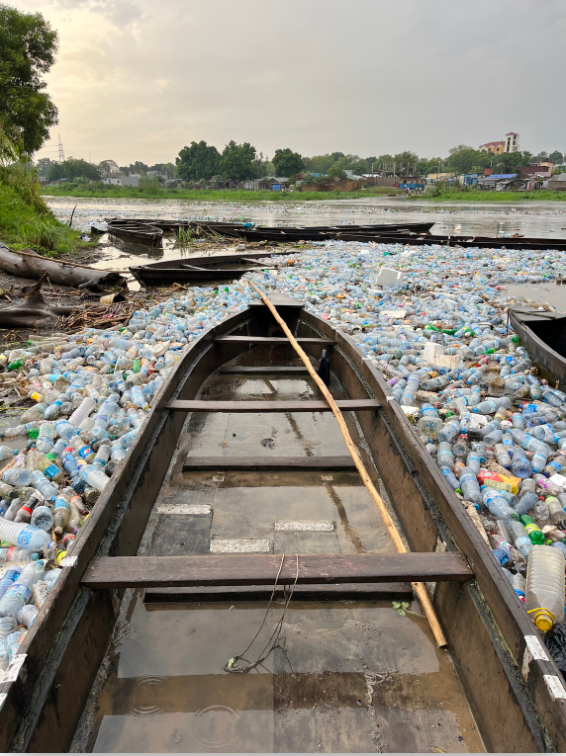
Philip's fishing boat ensnared among plastic waste in the river. Photo courtesy of Butros Nicola and Adam Ibrahim. Bahr Al Jabal river, Juba, South Sudan
From a health perspective, Makuch elaborated, “plastic bottles cannot hold another substance after its original material; it should be recycled anew, it is a material that best preserves microbes and germs, and things that transmit diseases.” His statement was challenging the reuse of bottles by traders, especially women in small-scale businesses who reused bottles to sell oil, juice, and locally made alcohol. In contrast, people think it is healthier to reuse them and will reduce harm to the environment, in fact that is totally wrong.
Local Voices, Local Action: Preserving Heritage from Plastic
“As of now, Save The Nile is in its inaugural year of operations… During our World Environment Day 2025 cleanup in the Honkong area, Amarat neighborhood, in Juba, we engaged over 20 volunteers and removed approximately 300 kgs of plastic waste from the streets,” said Makur Majeng, the founder of Save The Nile, a grassroots nonprofit based in Juba focused on protecting the Nile River from plastic pollution. Through clean-up campaigns, youth mobilization, and public awareness drives.

Plastic pollution along the riverside where fishermen work. Photo courtesy of Butros Nicola and Adam Ibrahim. Bahr Al Jabal river, Juba, South Sudan
During an online interview conducted with him, he compares the effort they have put in and the large scale of the crisis, noting that Juba's estimated daily waste generation is approximately 0.42 kg per capita, totaling around 336 tons per day for a population of 800,000.
Given that plastics constitute about 73% of this waste, the city generates approximately 245 tons of plastic waste daily. While Save the Nile's current efforts are modest relative to the city's total waste output, it is crucial to address this pressing environmental issue." Majeng elaborated.
Amid this young movement, another champion appeared on our way as we were producing the story: Eden Foundation. Established in 2019, Eden Foundation is a national nonprofit working toward environmental sustainability in South Sudan. Their flagship programs train university students and young professionals in eco-leadership, waste management, and cultural preservation. Among their recent activities was YouthEco Lab, a programme designed to equip young thinkers in how to realize effective preservation plans.

YouthEco-Lab training session on its first day. Photo courtesy of the Eden Foundation. Scenius Hub, Juba, South Sudan
Among the participants was Diana Robert, a 22-year-old student at the University of Juba, School of Rural Development and Community Studies. During the conversation, she shared her thoughts about how pollution can affect cultural heritage. She noted “when we look at many fundamental tribal ceremonies, such as Shilluk, the choosing of a new king is directly linked to the river as the main venue for that celebration". To her, that's why they are taking this training to preserve the river and environment, as well as the culture and identity they carry.
Juba's Policy Paralysis and Corporate Grip
Despite the tireless efforts of organizational bodies such as South Sudan Environment Preservation Society, Save The Nile, and Eden Foundation, a fundamental lack of top-down support stifles progress. However, at this level, Majeng outlined the multifaceted nature of these institutional failures. “Several systemic barriers limit our work. Firstly, the limited waste management infrastructure at the country level, with no formal recycling or plastic collection system. Secondly, government policies on environmental protection are still in early stages." he noted.
He added that some corporate practices, such as selling cheap, single-use plastic without responsibility for disposal, exacerbate the problem. Makuch further criticized the official inertia, saying “The government’s primary role is procrastinating in drafting an environmental protection law. The lack of such a framework means factories, many along the river, operate with little oversight.” In contrast, he told us that there is a private recycling company that takes the waste to process them- but in Uganda, highlighting Juba’s incomplete recycling infrastructure and reliance on external solutions.
Pathways to a Sustainable Nile
Regardless of the profound systemic challenges, Juba’s battles against plastic waste offer lessons for sustainable solutions. Makuch emphasized that “Combating plastic pollution requires alternative policies and plans that involve reducing reliance on bottled water factories and connecting pipes to the main stations to residential areas.” Such a shift would address the root cause as South Sudan still does not have a water pipe network.
Community-led organizations, such as Save The Nile, provide a tangible blueprint. Majeng asserted, “By demonstrating that small groups of committed citizens can reduce the amount of plastic before reaching the river, we provide a blueprint that other communities can adopt.” This grassroots approach builds local ownership.
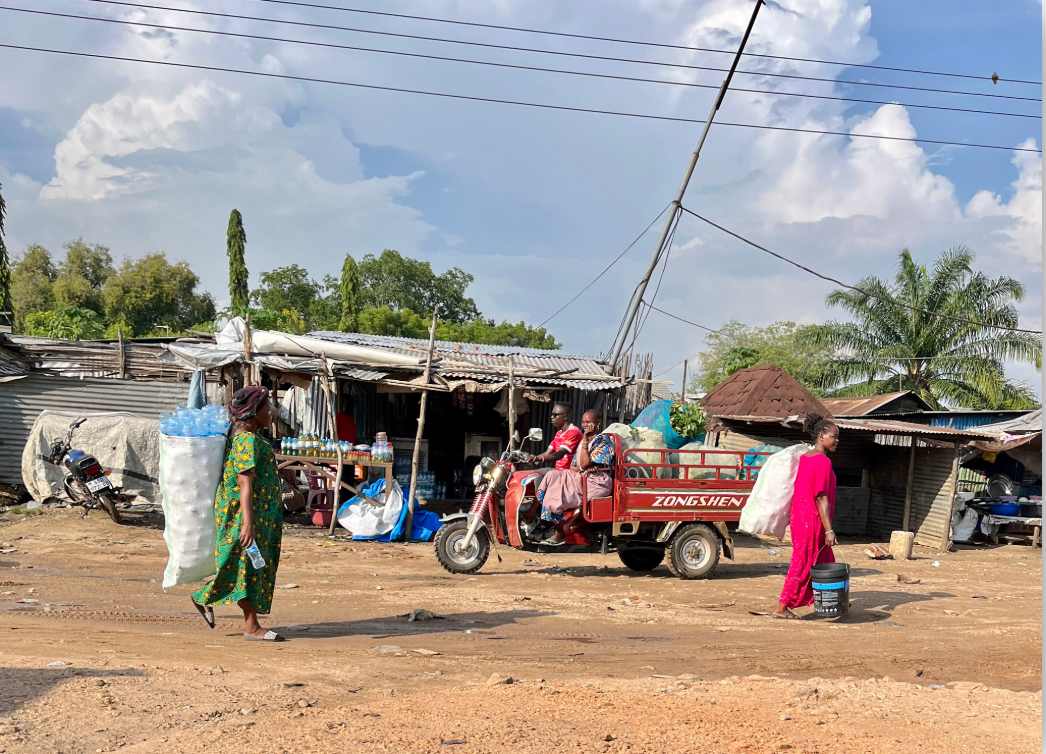
A woman carries plastic in her bag while another fills plastic bottles with oil in Jabal Nyoka district, Juba, South Sudan. Photo courtesy of Butros Nicola and Adam Ibrahim.
On a national level, these community efforts send a powerful message to policymakers according to Majeng. “Our approach shows policymakers that solutions do not have to wait for large-scale infrastructure,” he continued. Finally concluding, “community action can complement regulations, reinforce compliance, and create public demand for better waste management.”
As the whole world and specially South Sudan await the UN Plastics Treaty, the community movement highlights grassroots engagement’s value, showing national commitments succeed with community participation under global agreements. As Jada continues her daily routine at the river’s edge and Ladu fishes from his little boat, they see not only plastic but also growing youth participation in cleanups. It is a merger of personal struggles with burgeoning community action that symbolizes Juba’s complex fight. This merger offers hope for sustainable change, urging broader action from both government and corporations. Looking ahead, the future of the Bahr Al Jabal river and Juba’s identity, hinges on crucial synergy between robust policy frameworks and persistent community-led initiatives, ensuring this vital waterway flows clean and vibrant for generations to come.